
When genetics or injury limit what training can build, chest implants can add shape.
Pectoral implants add shape and projection to the chest for men whose muscles don't develop fully with training or who have asymmetry from birth or injury. The implants are made of soft solid silicone and placed under the chest muscle through a small incision in the armpit. Most men return to desk work within about a week and resume chest workouts after several weeks, as cleared by their surgeon.
Some chests don't respond to bench presses, and that's not a failure of effort. Genetics, muscle insertion points, and conditions present from birth all shape how the chest develops. For some men, no amount of training builds the fullness they're working toward. That's where pectoral implants in Newport Beach come in.
At The One Plastic Surgery Center, board-certified plastic surgeon Dr. Siamak Agha works with men who have trained for years without seeing the chest they want, as well as men with asymmetry caused by congenital conditions or injury. The goal is never an inflated look. It's a chest that looks like it belongs to the rest of the body.
This article explains why some chests don't respond to training, how pectoral implants work, who is a suitable candidate, and what recovery and results realistically look like.
Key Takeaways
- Pectoral implants add shape and projection to the chest when muscles don't develop fully through exercise alone.
- They are made of soft solid silicone, which is designed not to leak like a gel-filled breast implant.
- Implants are typically placed beneath the chest muscle through a small incision hidden in the armpit.
- Good candidates include men with underdeveloped chests, asymmetry, or conditions such as Poland syndrome.
- Most men return to light activity within about a week, with chest workouts resuming after several weeks as cleared.
Why Some Chests Don't Respond to Training
The chest is one of the most trained muscle groups in the gym and also one of the most frustrating for many men. Genetics play a large role in how muscles grow. The shape of the pectoralis major, where it attaches to the breastbone and ribs, and how much the muscle can grow all vary from person to person.
Some men have naturally narrow or flat chests that stay that way regardless of training. Others have one side that develops more than the other. Differences in muscle bulk, rib cage shape, or posture can make the chest look uneven, even in men who are very fit.
There are also medical causes. Poland syndrome is a congenital condition in which part or all of the pectoral muscle is missing on one side. Injuries, including muscle tears, can also leave the chest looking uneven. In these situations, exercise may improve strength but cannot rebuild missing tissue.
Understanding these limits matters. It shifts the conversation from "I'm not working hard enough" to "my anatomy has a ceiling," and that is often the moment men begin to consider surgical options.
What Pectoral Implants Are
Pectoral implants are soft, solid silicone implants that are shaped to mimic the pectoralis major muscle. Unlike breast implants, which are filled with saline or silicone gel, pectoral implants are designed to be firm enough to look and feel like muscle.
According to our pectoral implants page, the implants are typically made of a solid silicone material that looks and feels like natural pecs. Because they are solid rather than fluid-filled, they are designed not to leak.
Implants come in different shapes and sizes. Your surgeon will select dimensions based on the width of your chest, your existing muscle, and your goals. The aim is to enhance the chest in a way that matches your shoulders, arms, and overall frame.
How Pectoral Implant Surgery Is Performed
Pectoral implant surgery is usually performed under general anesthesia. The surgeon makes a small incision in the armpit, within the natural skin crease, where the scar can be hidden in the hair-bearing area.
Through this incision, the surgeon creates a pocket beneath the pectoralis major muscle.
According to StatPearls, a peer-reviewed medical reference, placing the implant under the muscle through an underarm approach has become the standard technique. This placement helps the implant look more natural and blend with the surrounding tissue.
The implant is positioned carefully to align with the natural edges of the muscle, and then the incision is closed. Some surgeons use drains to reduce fluid buildup, and patients typically wear a compression garment afterward to support healing.
In some cases, Dr. Agha may recommend combining pectoral implants with liposuction or fat transfer to refine the chest contour and create smoother transitions.
Who Is a Suitable Candidate, and What Are the Alternatives?
Good candidates for pectoral implants are healthy men with a stable weight who have underdeveloped chest muscles, asymmetry from birth or injury, or a chest that hasn't responded to training. Candidates should have realistic expectations about what implants can achieve.
Weight stability is important. As the practice notes, drastic weight gain or loss can affect the outcome, so men planning major body changes may want to wait until their weight has settled.
There are alternatives worth discussing. For men with enough donor fat and modest goals, fat transfer to the chest can add some volume without an implant, though some of the transferred fat is naturally reabsorbed. For men whose concern is excess breast tissue rather than a lack of muscle, gynecomastia surgery may be the more appropriate procedure. Some men benefit from both.
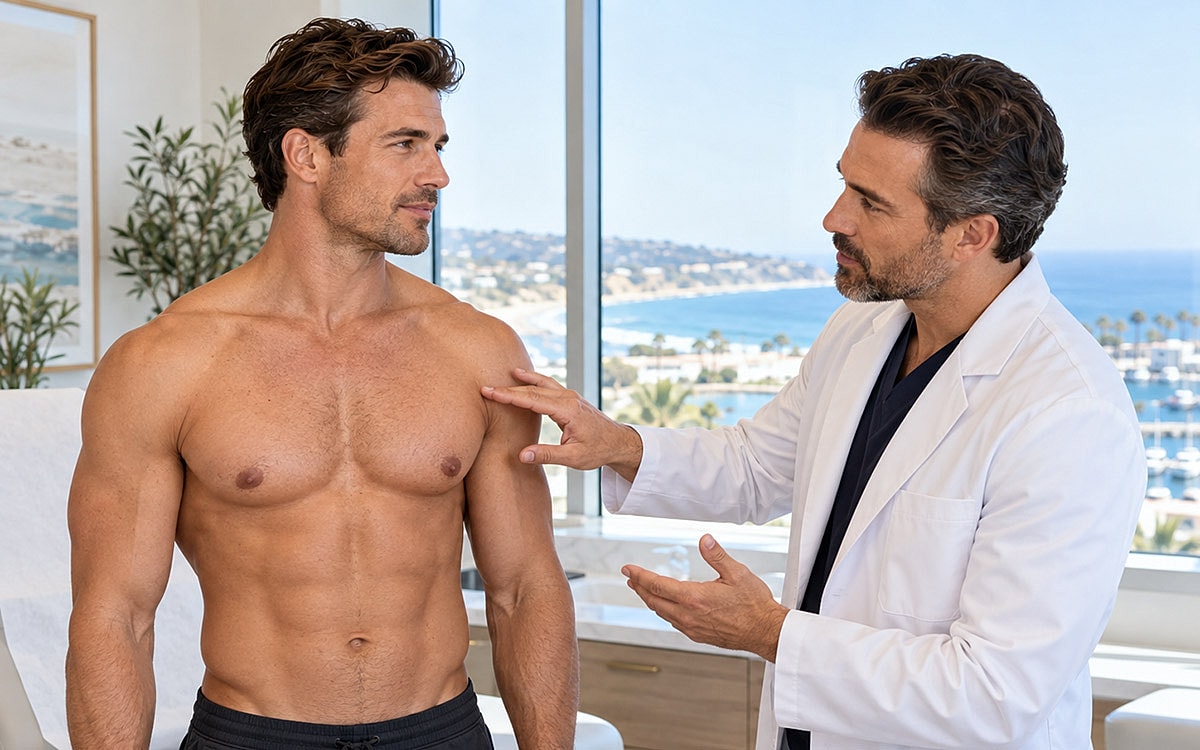
The consultation itself is where you and your surgeon will decide much of this. Your surgeon will measure your chest width, assess your existing muscle and skin, and look for asymmetry you may not have noticed. Many men bring photos of the look they want, which helps clarify whether their goal is subtle fullness or more noticeable projection. An honest surgeon will also tell you when a goal isn't realistic for your frame.
For those seeking a more comprehensive change, body masculinization combines several procedures to sculpt the chest, abdomen, and arms together.
Risks and Realistic Expectations
Like any surgery, pectoral implants carry risks. StatPearls lists possible complications, including bleeding, infection, seroma (fluid buildup), asymmetry, implant shifting, capsular contracture (tightening of scar tissue around the implant), scarring, and muscle spasm.
Choosing an experienced board-certified plastic surgeon and following recovery instructions closely help reduce these risks. Selecting an implant size that fits your frame is also important, since overly large implants may be more prone to problems and look less natural.
The best pectoral implants don't announce themselves; they simply make the chest look finished.
Realistic expectations matter too. Pectoral implants add shape and projection, but they don't replace the look of muscle definition that comes from low body fat and training. Many men find that implants combined with continued exercise give the most natural and satisfying result.
Recovery and Returning to the Gym
Most men can return to desk work within about a week after pectoral implant surgery.
Soreness and tightness in the chest are common in the first several days, and pain can usually be managed with medication.
A compression garment or vest is typically worn for several weeks to reduce swelling and help the implants settle. If drains are used, they are usually removed within the first week or so.
Returning to the gym takes patience. Walking and light activity can usually resume early, but chest exercises and heavy upper-body lifting typically need to wait several weeks. Your surgeon will guide when it's safe to resume training based on your healing. Returning too soon can increase the risk of implant shifting or fluid buildup.
Swelling gradually resolves over the first few months, and the implants settle into a more natural position. Final results are usually visible after about three months.
Long-term pectoral implants require little maintenance, but it's wise to keep regular follow-up visits and to report any new pain, firmness, or change in shape. Maintaining a stable weight and continuing to train helps the chest look balanced with the rest of your body. Many men in Newport Beach find that once recovery is complete, their workouts feel more rewarding because the chest finally matches the effort they put in.
Medical disclaimer: This article is for educational purposes only and is not medical advice. Results and candidacy vary by patient. A consultation is required to determine whether pectoral implants or an alternative procedure is appropriate for you.
Conclusion
Some chests simply don't respond to training, and that is a matter of anatomy, not effort.
Pectoral implants offer a way to add shape and projection when genetics, congenital conditions, or injury limit what exercise can build. With careful implant selection and a thoughtful surgical approach, the result can look like a natural extension of your physique.
If you've reached a limit in the gym, a consultation can help you determine whether implants, fat transfer, or another approach is appropriate.
Ready to find out if pectoral implants are right for you? Schedule a consultation with board-certified plastic surgeon Dr. Siamak Agha at The One Plastic Surgery Center in Newport Beach to discuss your goals and options.
Frequently Asked Questions
What are pectoral implants made of?
Pectoral implants are made of soft, solid silicone shaped like the chest muscle. Because they are solid rather than fluid-filled, they are designed not to leak. They are chosen in sizes and shapes to fit your frame.
Where is the incision for pectoral implants?
The incision is usually made in the armpit, within a natural skin crease. This location allows the scar to be hidden in the hair-bearing area of the underarm.
How long after pectoral implants can I work out?
Walking and light activity can usually resume early, but chest workouts and heavy lifting typically need to wait several weeks. Your surgeon will tell you when it's safe based on your healing.
Can pectoral implants help with Poland syndrome?
Yes. Poland syndrome involves a missing or underdeveloped chest muscle on one side, and implants can help restore a more balanced chest contour. Treatment is tailored to each patient's anatomy.
Are pectoral implants permanent?
Pectoral implants are intended to be long-lasting, but no implant is guaranteed to last a lifetime. Some men may need revision surgery in the future due to shifting, capsular contracture, or changes in their body.