

For patients who have experienced massive weight loss, the thighs can present some of the most complex challenges in body contouring.
The thigh is the part of the lower extremity that spans between the abdomen and the knees. From the front, the thighs are separated from the abdominal region and groin area, including the mons, by the groin crease. From behind, the upper thigh is separated from the lower buttock by a well-defined crease known as the infra-gluteal fold, which is the continuation of the groin crease beneath the buttocks.
After weight loss, the degree and pattern of thigh tissue laxity can vary considerably depending on genetics, gender, the amount of weight lost, current weight, muscle tone and structure, and overall body shape. Patients with an apple-shaped body may experience less pronounced changes in the thighs than patients with a pear-shaped body who tend to carry more weight through the hips and thighs.
In many weight loss patients, deflation of the thighs creates tissue laxity in two directions: vertical and horizontal, or circumferential. Vertical laxity may appear as inner thigh rolls extending backward beneath the buttocks, prominent saddlebags along the outer thighs, dimpling and looseness along the front of the thighs, and excess tissue around the knees.
Some patients also develop horizontal or circumferential laxity, leaving the thighs wider because of excess skin and tissue around the circumference of the legs.
This is often most noticeable along the inner thighs and may extend below the inner knees into the upper calves. The resulting skin folds can rub together, cause irritation and discomfort, interfere with clothing, and affect intimacy for some patients.
Correcting these deformities requires more than simply removing excess skin—it requires an understanding of how the tissues have changed and how the thighs relate to the buttocks, hips, abdomen, and lower body as a whole.
Dr. Siamak Agha is recognized for his extensive experience in advanced thigh surgery, having performed more than 400 thigh lift and thighplasty procedures. Based on his documented surgical experience, he has performed one of the highest numbers of thigh lift procedures worldwide. His expertise extends beyond surgical volume: Dr. Agha has also pioneered innovative approaches to thigh contouring, including his Anterior Thigh Lift and Spiral Thigh Lift techniques.
This combination of extensive clinical experience and innovation has allowed Dr. Agha to develop and refine techniques designed to address the complex and varied patterns of skin and soft-tissue laxity that can occur following massive weight loss. His approach emphasizes individualized surgical planning, with the goal of restoring proportion, contour, and function while addressing each patient's unique anatomy.
At The One Plastic Surgery Center in Newport Beach, Orange County, Dr. Siamak Agha has devoted a substantial part of his practice to treating the complex patterns of thigh laxity seen in weight-loss patients.
Dr. Agha performs on average about 36 thighplasties per year and has performed 614 thighplasties in total. For comparison, the 2012 ASAPS Member Practice Profile, published by the American Society for Aesthetic Plastic Surgery, reported that the average ASAPS member performed 1.2 thigh lifts per year. ASAPS members were board-certified plastic surgeons specialized in cosmetic surgery of the face and body. Compared with this published professional benchmark, Dr. Agha currently performs at least 30 times more thigh surgeries than an average plastic surgeon per year.
Dr. Agha’s experience is also grounded in studying how the thighs change after substantial weight loss. In his study of 100 weight-loss patients, all demonstrated some degree of vertical thigh laxity involving the inner, outer, front, and back of the thighs. Approximately 40 percent also had horizontal, or circumferential, thigh laxity, particularly along the inner thighs.
These different patterns matter because downward sagging and excessive thigh circumference are not the same problem and may require different surgical solutions. This understanding has shaped Dr. Agha’s approach to post-weight-loss thigh contouring, distinguishing procedures designed to lift descended thigh tissue from those designed to reduce excessive thigh circumference.
In 2007, Dr. Agha and Dr. Dennis Hurwitz pioneered the Spiral Thigh Lift, a technique developed to provide a powerful lift of the inner and posterior thighs in weight-loss patients. Dr. Agha has also developed an anterior thigh lift technique to address looseness along the front of the thighs, an area not directly treated by traditional inner thigh lift surgery.
Because thigh contour is closely connected to the abdomen, hips, waist, and buttocks, Dr. Agha may also integrate thigh lifting with procedures such as a High-Definition Lower Body Lift™, tummy tuck, or other post-weight-loss body contouring procedures when appropriate.

Thighplasty after weight loss refers to surgical procedures designed to remove excess thigh skin and fat and reshape thighs affected by significant tissue laxity after major weight reduction. Unlike patients with more limited upper inner thigh looseness, weight-loss patients may have excess tissue involving the inner, outer, front, and back of the thighs, sometimes extending around the knees and into the upper calves.
Dr. Agha makes an important distinction between a thigh lift and a thighplasty. He uses the term thigh lift to describe procedures that elevate descended thigh tissue in a vertical direction and reserves the term thighplasty for procedures that reduce horizontal, or circumferential, thigh excess. Some patients require lifting, some require lipo-debulking, while others need reduction of the thigh circumference.
Thigh surgery after weight loss is particularly challenging because the thigh contour is heavily influenced by adjacent regions such as the abdomen, waist, hips, and buttocks. Rather than viewing the thigh in isolation, Dr. Agha evaluates the entire lower-body contour. Careful planning is therefore essential to achieve a result that is proportionate and harmonious with the surrounding anatomy. A successful procedure should reduce unwanted tissue, improve thigh descent, preserve or reconstruct important anatomical creases, and place scars as inconspicuously as the patient’s anatomy allows.
At The One Plastic Surgery Center in Newport Beach, Orange County, Dr. Agha employs his vast experience in thigh surgeries to offer several thigh lift and thighplasty techniques
1. Outer Thigh Lift An outer thigh lift elevates loose tissue along the outer thighs and improves outer thigh laxity, prominent saddlebags, and excess tissue extending toward the waist. It is commonly performed as part of a lower body lift or 360° thigh lift.
2. Anterior (Front) Thigh Lift Dr. Agha developed an anterior thigh lift technique to address vertical laxity along the front of the thighs. It is generally performed as part of an extended tummy tuck, lower body lift, or 360° thigh lift.
3. Medial Inner Thigh Lift A medial inner thigh lift addresses looseness concentrated in the upper inner thigh. It does not significantly elevate the front or back of the thighs and is less extensive than the Spiral Thigh Lift.
4. Posterior Thigh Lift A posterior thigh lift elevates loose tissue along the back of the upper thighs and reconstructs the natural crease separating the buttocks from the thighs. In Dr. Agha’s approach, posterior thigh lifting is incorporated into the Spiral Thigh Lift.
5. Spiral Thigh Lift Pioneered by Drs. Agha and Hurwitz, the Spiral Thigh Lift combines inner and posterior thigh lifting to address the more extensive vertical laxity commonly seen after major weight loss.
6. 360° Thigh Lift (Circumferential Thigh Lift) A 360° thigh lift, also known as a circumferential thigh lift, combines outer, anterior, inner, and posterior thigh lifting to address vertical laxity around the entire thigh.
7. Thigh Lipo-debulking. For patients who have large thighs despite massive weight loss, or thigh lipedema, Dr. Agha recommends circumferential large volume liposuction of the thighs (i.e. 5 liters of liposuction) before a vertical thighplasty surgery.
8. Vertical Thighplasty With or Without Liposuction Vertical thighplasty reduces excessive thigh circumference by removing loose skin and tissue along the inner thigh. Dr. Agha may combine the procedure with thigh liposuction when additional reduction is needed.

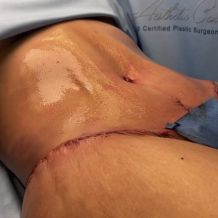
An outer thigh lift is the most effective component of any thigh lift procedure. In his experience, Dr. Agha has removed from 4 to 15 inches of outer thigh and waist excess tissues from his patients. The procedure is normally done as part of a lower body lift or circumferential thigh lift. Once the upper and lower incisions of the outer thigh lift are made, the excess waist and outer thigh tissue are excised over the muscle and fat. The outer thigh tissue is then partially separated from the underlying muscles using a specialized instrument known as a Lockwood dissector. The outer thigh tissue is then lifted and anchored at a higher position to the underlying muscles using multiple sutures. The waist incision is then lowered and sutured to the lifted outer thigh incision in 3 layers.
An actual anterior thigh lift has not been described in plastic surgery textbooks and does not formally exist. This is another procedure that Dr. Agha has pioneered for his patients. During this procedure, incisions are made over the upper thighs, 1-2 inches below the thigh/abdomen junction. Similar to the outer thigh lift, the tissue of the thigh front is loosened, lifted, and anchor-sutured to the underlying pubic bone. The abdominal incision is then sutured to the lifted anterior thigh incision in 3 layers. An anterior thigh lift is normally done at the time of a tummy tuck or a lower body lift.
A medial inner thigh lift addresses loose tissue concentrated along the upper inner thigh. This is the thigh lift technique that is typically used for non-bariatric patients or patients whose laxity is limited primarily to the upper inner thigh.
During the procedure, excess skin and tissue are removed from the upper inner thigh and the remaining tissue is elevated toward the groin crease. The goal is to improve looseness along the inner thigh while keeping the incision within or near the natural groin crease when the patient’s anatomy allows.
A medial inner thigh lift does not elevate the back or front of the thigh. Weight-loss patients with more extensive laxity involving the posterior thigh may therefore require a Spiral Thigh Lift, while patients with laxity affecting multiple surfaces of the thighs may require a 360° thigh lift.
A posterior thigh lift addresses vertical laxity along the back of the upper thighs. After major weight loss, loose tissue may descend beneath the buttocks while the infra-gluteal fold, or natural buttock crease, becomes stretched or poorly defined. When this happens, the lower buttocks and upper thighs can begin to blend together.
Posterior thigh lifting uses an incision along the infra-gluteal crease beneath the buttock and another along the upper posterior thigh. A crescent of excess tissue is removed from the back of the upper thigh, and the remaining thigh tissue is elevated and secured at a higher position with multiple sutures.
The infra-gluteal fold is then reconstructed to restore the natural transition between the buttock and thigh. When needed, Dr. Agha can reposition this fold at a higher level to improve the shape and relationship of the lower buttock and upper thigh.
In Dr. Agha’s approach to post-weight-loss thigh contouring, the posterior thigh lift is incorporated into the Spiral Thigh Lift, allowing the back and inner thighs to be lifted together when both areas are affected.
As patients lose weight, many end up with inner thigh and thigh back tissue laxity. Often patients complain about a fold of skin below the groin crease on the inner aspect of their thighs. Often, the inner thigh fold extends under the buttock crease (infra-gluteal crease) as what is known as a banana roll. Furthermore, the infra-gluteal crease can become loose. When this happens, the junction between the lower buttocks and upper thigh is lost. The buttocks and the thighs blend together, altering and blurring the shape of both the buttocks and thighs.
The Spiral Thigh Lift is a signature thigh lift procedure pioneered by Drs. Agha and Hurwitz in 2007. Termed the “Spiral Thigh Lift” by Dr. Siamak Agha, this thigh lift procedure corrects for the vertical laxity of the back and inner surfaces of the thigh.
The Spiral Thigh Lift surgery begins with an incision at the infra-gluteal crease that separates the buttock cheek from the upper thigh. A second incision is then made over the upper thighs parallel to the infra-gluteal incision.
A crescent of excess tissue on the back of the upper thigh is removed through this incision and then the upper thigh tissue is lifted to a higher position and secured to the underlying tissues via multiple permanent sutures. In this fashion, the lifted thigh tissue is permanently anchored. Next, the infra-gluteal crease is reconstructed, enhancing the shape of the buttocks and thigh. Dr. Agha is able to lift the infra-gluteal fold if needed and reconstruct it at a higher position. This controls the shape and height of the buttocks.
Both of the incisions of the Spiral Thigh Lift are then continued on the inner thigh over the groin crease and parallel to it. Through these incisions, excess skin and fat of the inner thigh are removed, the inner thigh is lifted and then anchored multiple times with permanent sutures at an elevated position. The groin crease is then meticulously reconstructed to create an inconspicuous scar. The final scar of the Spiral Thigh Lift ends up in the infra-gluteal crease and the groin crease.
A 360° thigh lift, also known as a circumferential thigh lift, is designed for patients with vertical laxity involving multiple surfaces of the thighs rather than one isolated region.
The procedure combines an outer thigh lift, anterior thigh lift, and Spiral Thigh Lift. Because the Spiral Thigh Lift includes both inner and posterior thigh lifting, the combined approach addresses vertical laxity around the front, outer, inner, and back of the thighs.
A 360° thigh lift may be incorporated into a broader post-weight-loss body contouring plan because the thighs are closely connected to the hips, waist, buttocks, and abdomen. The combination allows these different areas of thigh descent to be addressed together rather than treating each surface in isolation.
For patients who continue to have large, heavy thighs despite massive weight loss, including some patients with thigh lipedema, Dr. Agha may recommend circumferential large-volume thigh liposuction as a separate first-stage procedure before a vertical thighplasty. This staged approach reduces excess fatty volume throughout the thigh before loose skin is surgically removed and tightened.
Thigh lipo-debulking can address fatty prominence of the inner thighs, outer thighs or saddlebags, banana rolls beneath the buttocks, inner knees, and the front and back of the thighs. Depending on the patient’s anatomy, liposuction may be limited to one or several areas or performed circumferentially around the entire thigh. In larger-volume cases, Dr. Agha may remove up to approximately five liters of fat from both thighs across all four surfaces. Reducing this excess volume first can make the subsequent vertical thighplasty more focused on removing and reshaping the remaining loose skin.
For patients who have horizontal thigh excess, a vertical thighplasty, which is a thigh reduction procedure is needed in order to remove the excess inner thigh skin. Many plastic surgeons call this procedure a vertical thigh lift incorrectly. The vertical thighplasty is not a lift and should not be called a vertical thigh lift.
Vertical thighplasty involves removing a large elliptical section of skin and tissue from the inner thigh. This is done through a vertical incision that runs from the groin crease all the way to the inner knees or below the inner knees if needed. The incision is placed on the inner aspect of the thighs so that it is well hidden. In this manner the thigh circumference can be reduced by about 25 to 33% in most patients. In our practice, a vertical thighplasty is the recommended procedure for about one third of patients who need a thigh contour correction. Following the vertical thighplasty, many patients elect to have an outer thigh lift together with the spiral thigh lift in order to achieve complete circumferential thigh lift of their reduced thighs.
Please follow us @drsiamakagha to learn what makes Dr. Agha unique and special, learn from his educational podcasts and consults, and view precision surgery after surgery.