

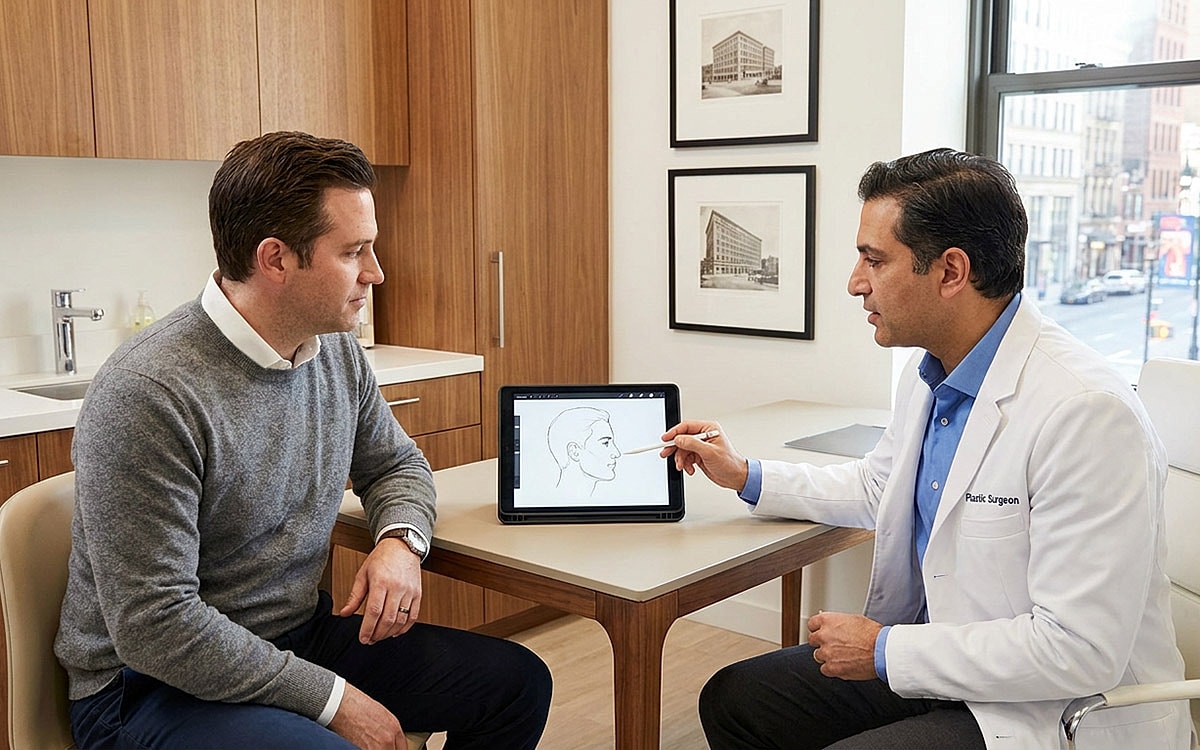
A male facelift Newport Beach patients trust isn't a smaller version of a standard facelift. Men have thicker skin, different fat distribution, and beard-bearing skin near the ear, which change incision placement, surgical depth, and how tension is applied. Done correctly, results look rested and natural, not "worked on." Recovery follows a similar timeline to a traditional facelift, but technique and planning differ from the first consultation.
What Makes a Male Facelift Different From a Traditional Facelift
A male facelift uses the same core surgical principles as a traditional facelift but adjusts incision placement, tissue handling, and skin tension to match male anatomy. The goal isn't a softer, more feminine face. It's a rested, natural version of the same masculine face the patient has always had.
Facelift surgery in general works by repositioning the deeper facial tissues, not just pulling skin tight. According to the American Society of Plastic Surgeons, the procedure addresses sagging in the cheeks, jawline, and neck by lifting supportive tissue layers back toward their original position, then redraping the skin over that structure. For men, the difference is in how and where that lifting happens, because the underlying tissue behaves differently than it does in female patients.
Men researching this procedure are often private about their decision and want practical facts: what changes, what stays the same, and what to expect. That's the point of this guide.
How Male Facial Anatomy Changes the Surgical Plan
Male skin is generally thicker, has a higher density of collagen, and carries more oil-producing glands than female skin, which changes how it responds when lifted and repositioned during surgery. Men also tend to have a heavier bone structure, particularly along the jaw and brow, and fat that sits more diffusely across the face rather than concentrated in specific pockets.
Thicker skin holds tension differently. It can tolerate firmer support from the deeper tissue layers, but it also tends to show scarring and swelling in a more visible way if the technique is careless. A surgeon has to account for a heavier, more vascular tissue bed, which affects everything from where incisions go to how much tissue is repositioned versus removed.
Fat distribution matters too. Women often carry fat higher in the cheeks, while men tend to hold more volume along the jowls and neck. Because of that, a male facelift often puts more emphasis on jawline and neck definition rather than cheek volume, which is one reason an SMAS facelift approach is chosen carefully based on where a given patient's aging shows up first.
Incision Placement and the Beard Line
In a male facelift, incisions are typically placed at the junction between beard-bearing skin and smooth skin in front of the ear, rather than tucked further back the way they often are for female patients. This placement keeps the beard line intact and prevents hair-bearing skin from being pulled into areas where a beard shouldn't grow.
Female facelift incisions can often move further back behind the ear because there's no beard pattern to protect. In men, pulling skin too far posteriorly can drag beard-growing skin onto the tragus, the small cartilage flap in front of the ear canal, which creates a patch of unwanted hair growth in a spot that's difficult to hide or shave. Careful planning of the incision line, along with a more vertical direction of pull rather than an oblique one, helps preserve the natural hairline and beard pattern.
This is one of the most technical parts of a male facelift, and it's also one of the easiest details to get wrong in inexperienced hands. It's a particularly important question to raise directly during a consultation, since incision planning should be customized to each patient's own beard growth and hairline.
Techniques Surgeons Use to Keep Male Results Natural
Many surgeons now favor a deep plane facelift approach for male patients because it repositions the deeper structural layers of the face rather than relying mainly on skin tension. That structural lift tends to hold up better on thicker male skin and avoids the pulled, wind-tunnel look that can happen when a surgeon leans too heavily on surface tightening alone.
A male facelift should restore a rested version of the same masculine face, not a smoother, softer one.
Preserving a strong jawline is a specific technical goal in male facelift surgery. Over-tightening or removing too much tissue around the jaw and neck can soften a feature that defines a masculine profile, which is the opposite of what most male patients want. Surgeons who regularly treat male patients, plan around the jaw and neck first, then adjust the mid-face only as much as needed.
Recovery After a Male Facelift
Recovery from a male facelift generally follows the same broad timeline as a traditional facelift: noticeable swelling and bruising in the first one to two weeks, stitch removal around day seven, and a return to most normal, non-strenuous activities by around two weeks. Full results can take several months to settle.
The American Society of Plastic Surgeons notes that the first days after surgery often bring grogginess and tightness, with swelling and bruising peaking within the first week or two before gradually resolving. Men may notice a slightly longer initial swelling phase in some cases due to thicker skin and a more vascular tissue bed, though the duration varies by patient and by the extent of the procedure performed.
A few practical notes matter more for men during recovery:
- Shaving typically needs to be paused for one to two weeks near the incision sites until swelling and sensitivity settle.
- Facial hair may grow in unevenly near the incision at first as swelling resolves; this phenomenon generally normalizes over the following weeks.
- Following post-operative care instructions around activity, sun exposure, and wound care has a real effect on how incisions heal and scar.
How to Avoid the "Done" Look
The most reliable way to avoid an overdone appearance in a male facelift is choosing a technique that restores structure rather than one that simply pulls skin tighter, paired with a surgeon experienced in male anatomy. Overcorrection, whether from excess skin removal or too much tension, tends to create the stretched, artificial look that men want to avoid.
Because men tend to research this decision more privately and skip the trial-and-error process with injectables that many women go through first, the surgical plan is more consequential. A conservative, structure-first approach, rather than an aggressive one, is generally what produces a result that reads as "well rested" instead of "surgically altered." Skin quality and health going into surgery also affect the outcome. Nonsmokers in good general health with realistic expectations tend to see smoother healing and more predictable results, a point echoed across major reference sources on facelift candidacy, including information published on facelift procedures by Cleveland Clinic.
Choosing a Surgeon for a Male Facelift in Newport Beach
Choosing a surgeon for a male facelift means finding someone with specific, demonstrated experience in male facial anatomy, not just general facelift volume. Ask to see male-specific before-and-after results, and ask directly how the surgeon handles beard-line incisions and jawline preservation.
Newport Beach patients have access to board-certified plastic surgeon Dr. Siamak Agha, who evaluates each male facelift patient individually, factoring in skin thickness, beard pattern, bone structure, and the patient's own goals before recommending a technique. A male facelift is not a one-size-fits-all procedure, and the right plan for one patient's jawline and hairline may not be right for another's.
Medical Disclaimer
This article is for general educational purposes and is not a substitute for personalized medical advice. Results and candidacy vary by patient, and a consultation is required to determine whether a male facelift is right for your anatomy and goals.
Ready to Learn More?
A male facelift is a technical procedure with real differences from a standard facelift, from incision placement along the beard line to how tension and structure are handled around the jaw and neck. Understanding those differences ahead of time makes it easier to have a direct, informed conversation with a surgeon rather than guessing at what to expect.
Ready to find out if a male facelift is right for you? Schedule a consultation with board-certified plastic surgeon Dr. Siamak Agha at The One Plastic Surgery Center in Newport Beach to discuss your goals and options.
FAQ
Is a male facelift performed differently than a traditional facelift?
Yes. A male facelift uses the same underlying surgical principles as a traditional facelift, but incision placement, skin tension, and technique are adjusted for thicker skin, beard-bearing tissue, and a heavier bone structure. The goal is a natural, masculine result rather than a softened or feminized one.
Where are the incisions placed in a male facelift?
Incisions are typically placed at the junction of beard-bearing and non-hair-bearing skin in front of the ear, rather than further back behind the ear. This placement helps prevent beard-growing skin from being pulled into unwanted areas, such as the tragus.
How long is recovery after a male facelift?
Most patients see initial swelling and bruising resolve within one to two weeks, with stitches typically removed around day seven and a return to normal activities around the two-week mark. Full, settled results can take a few months to appear.
Will a male facelift make my face look feminine or "done"?
A well-planned male facelift is designed to preserve masculine features like a strong jawline, not soften them. Choosing a structure-based technique, such as a deep plane approach, and a surgeon experienced in male anatomy helps avoid an overdone or artificial appearance.
Who is a good candidate for a male facelift?
Good candidates are generally nonsmokers in good overall health with moderate to advanced signs of facial or neck aging and realistic expectations about the outcome. Candidacy varies by individual, which is why a consultation with a board-certified plastic surgeon is necessary before moving forward.
Recent Post
-
Mini Facelift vs. Full Facelift: Which Is Right for You?
-

The Art of the Modern Facelift: Subtle Enhancements for Natural Results
-

Combining Facelift and Neck Lift: Achieving Complete Facial Harmony
-

How Long Do Facelift Results Last?
-

The Ultimate Mommy Makeover Guide: Restoring Confidence After Motherhood