


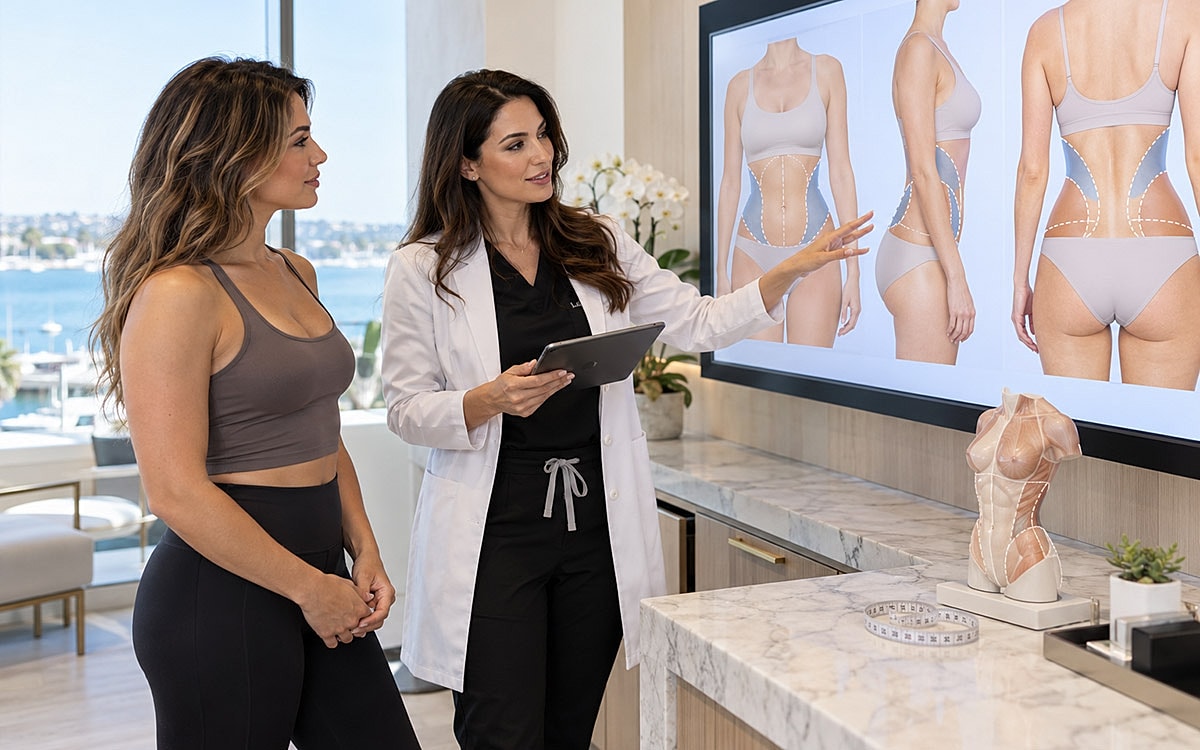
Why treating the front, back, and sides together creates a more natural waistline than spot liposuction.
Lipo 360 is liposuction that treats the entire midsection in one procedure, including the abdomen, flanks, waist, and back. Because it works all the way around the body, it can create a smoother, more balanced shape than treating one area alone. Good candidates are near a stable, healthy weight with good skin elasticity. Most patients return to light activity within about a week, wear compression for several weeks, and see most of their results by around six weeks.
Your body doesn't have a single problem area. It has a shape, and that shape continues around your sides and across your back. That idea is the heart of Lipo 360 in Newport Beach, and it explains why so many patients who once asked for "just my stomach" end up choosing a circumferential approach.
At The One Plastic Surgery Center, board-certified plastic surgeon Dr. Siamak Agha approaches body contouring by looking at the whole torso, front and back, rather than isolated pockets of fat. As he often explains to patients, a flatter stomach can look unfinished if the flanks and lower back are left untouched.
This article explains why spot liposuction sometimes falls short, what Lipo 360 involves, who is a suitable candidate, how safety is managed, and what recovery and results realistically look like.
Key Takeaways
- Lipo 360 treats the abdomen, flanks, waist, and back together to create a balanced, natural-looking midsection.
- Treating only the stomach can leave the sides and back looking fuller, which may make results appear uneven.
- Ideal candidates are close to a stable weight, with a BMI under 35 and preferably closer to 30, and healthy skin elasticity.
- Research published by ASPS suggests safe liposuction volume depends on each patient's body mass index rather than one fixed limit.
- Most patients resume light activity within a week and wear compression garments for six weeks to three months.
Why Spot Liposuction Can Leave the Midsection Unbalanced
For years, liposuction was often discussed one area at a time: the lower belly, the love handles, and the bra roll. That approach made sense for small, isolated concerns. But the torso is a continuous structure, and fat rarely stops neatly at the boundaries of a single treatment zone.
When only the front of the abdomen is treated, the flanks and lower back can appear relatively fuller by comparison. In clothing, this phenomenon sometimes shows up as a waist that looks flat from the front but wide from the side. In photos taken from behind, the lower back may look unchanged.
The lower back is a common source of disappointment after limited liposuction, and it is also one of the most frequent reasons patients seek additional contouring later. It isn't that the original procedure failed. It simply addressed one view of a three-dimensional shape.
Lipo 360 was developed to solve that problem. By treating the midsection all the way around, the surgeon can shape the waist as a whole, taper the flanks into the hips, and smooth transitions between areas so the result looks cohesive from every angle.
What Lipo 360 in Newport Beach Treats
Lipo 360 in Newport Beach typically treats the upper and lower abdomen, the flanks (love handles), the waist, and the lower and mid back. Some patients also include the upper back or bra-line area, depending on their anatomy and goals.
According to our Lipo 360 page, the procedure is designed to target the front, back, and flanks at the same time. That comprehensive approach allows the surgeon to create a defined waistline and smooth curves rather than isolated flat spots.
The exact plan depends on where you carry fat, how your skin behaves, and what shape you want. A patient with fullness mostly in the flanks and back will have a different emphasis than someone whose concern is primarily the lower abdomen.
How Lipo 360 Is Performed
Dr. Agha uses a combination of techniques for Lipo 360. The practice describes pairing VASER, a form of ultrasound-assisted liposuction, with power-assisted liposuction.
Ultrasound energy helps loosen fat before it's removed, while the power-assisted cannula moves with small vibrations to make fat removal smoother and more controlled.
Before any fat is removed, a tumescent solution is typically injected into the treatment areas.
This fluid contains a local anesthetic and medication that constricts blood vessels, which helps reduce bleeding and discomfort. Small incisions, usually just a few millimeters long, are placed in discreet locations such as the belly button, the lower back, or natural creases.
Because the procedure treats the body all the way around, patients are usually repositioned during surgery so the surgeon can access the front, sides, and back. The focus throughout is on even, smooth contouring rather than removing as much fat as possible.
Who Is a Suitable Candidate for Lipo 360?
The best candidates for Lipo 360 are at or near a stable, healthy weight and have stubborn fat that hasn't responded to diet and exercise. The practice recommends a BMI below 35, with a BMI closer to 30 or lower preferred, and optimal skin elasticity so the skin can contract smoothly after fat is removed.
Skin quality matters as much as fat. Liposuction removes fat, but it doesn't remove loose skin. If your abdominal skin is lax, for example after pregnancy or major weight loss, removing fat alone may leave the skin looking deflated. In those cases, a tummy tuck or a combination approach may give a better result.
Health matters too. Nonsmokers heal more reliably, and conditions such as diabetes or heart disease should be well controlled. Lipo 360 is not a weight-loss procedure. It's a shaping procedure for people who are already close to their goals.
Safety and How Much Fat Can Be Removed
One of the most common questions about Lipo 360 is how much fat can safely be removed.
For many years, removing more than 5,000 milliliters was considered large-volume liposuction, a threshold used to guide safety planning.
A study published in the ASPS journal, Plastic and Reconstructive Surgery, took a closer look.
Analyzing more than 4,500 patients, researchers found an overall complication rate of about 1.5 percent, with major complications in fewer than 1 in 1,000 patients. They concluded that safe volume is better judged relative to a patient's body mass index than by a single fixed number.
A great Lipo 360 result is measured by balance and smoothness, not by how much fat is removed.
In practice, this means your surgeon should plan the amount of fat removed around your body, not a generic target. The ASPS practice advisory on liposuction also emphasizes careful fluid management, appropriate facility selection, and attention to patient health when planning larger volumes.
Possible risks include swelling, bruising, fluid collection (seroma), contour irregularities, numbness, infection, and, rarely, blood clots. Choosing an experienced board-certified plastic surgeon, following preoperative instructions, and walking soon after surgery all help reduce risk.
Lipo 360 Recovery and Results
Most patients can return to normal daily activities or light exercise within about one week after Lipo 360. Swelling and bruising are expected early on and gradually improve over the following weeks.
Compression garments are an important part of recovery. The practice recommends wearing compression for six weeks to three months, depending on your healing and the extent of treatment. Compression helps control swelling and supports the skin as it adapts to your new contours. Many patients also benefit from lymphatic massage, if recommended by their surgeon, to help with fluid and firmness.
Results appear gradually. According to the practice, most patients see about 80 to 90 percent of their results by about six weeks, with the final shape settling over up to six months as residual swelling resolves. Fat cells removed during liposuction don't come back, but remaining fat cells can still grow with weight gain, so maintaining a stable weight helps preserve the result.
Pairing Lipo 360 With a BBL or Tummy Tuck
Lipo 360 is often combined with other procedures to enhance the overall shape. One of the most popular pairings is with a Brazilian butt lift. The fat removed from the midsection can be purified and transferred to the buttocks, which creates contrast between a slimmer waist and fuller hips.
For patients with loose abdominal skin or separated abdominal muscles, pairing Lipo 360 with a tummy tuck can address both fat and skin. The tummy tuck tightens the abdominal wall and removes excess skin, while Lipo 360 refines the flanks and back.
Combining procedures can mean one recovery instead of two, but it also means a longer operation. Your surgeon will weigh the benefits and safety considerations based on your health and goals.
Medical disclaimer: This article is for educational purposes only and is not medical advice. Results and candidacy vary by patient. A consultation is required to determine whether Lipo 360 or any related procedure is appropriate for you.
Conclusion
The idea behind Lipo 360 is simple: your midsection is one connected shape, and treating it that way often leads to a more natural result. By addressing the abdomen, flanks, waist, and back together, the procedure can create smoother lines and a more balanced silhouette than spot liposuction alone.
The best results come from careful candidacy, a plan built around your body, and patience while swelling settles.
Ready to find out if Lipo 360 is right for you? Schedule a consultation with board-certified plastic surgeon Dr. Siamak Agha at The One Plastic Surgery Center in Newport Beach to discuss your goals and options.
Frequently Asked Questions
What areas does Lipo 360 treat?
Lipo 360 typically treats the upper and lower abdomen, flanks, waist, and lower and mid back. Some patients also include the upper back or bra-line area. The exact areas depend on your anatomy and goals.
What BMI do you need for Lipo 360?
The practice recommends a BMI below 35, with a BMI closer to 30 or lower being preferred. Good skin elasticity and a stable weight are also important for smooth results.
How long is recovery after Lipo 360?
Most patients return to normal daily activities or light exercise within about a week. Compression garments are worn for six weeks to three months. Final results develop over up to six months as swelling resolves.
Can Lipo 360 remove loose skin?
No. Liposuction removes fat but does not remove excess skin. If you have loose skin, a tummy tuck or another skin-tightening procedure may be recommended alongside or instead of Lipo 360.
Can Lipo 360 be combined with a BBL?
Yes. Fat removed during Lipo 360 can be transferred to the buttocks in a Brazilian butt lift. This combination slims the waist while adding fullness to the hips and buttocks.






