


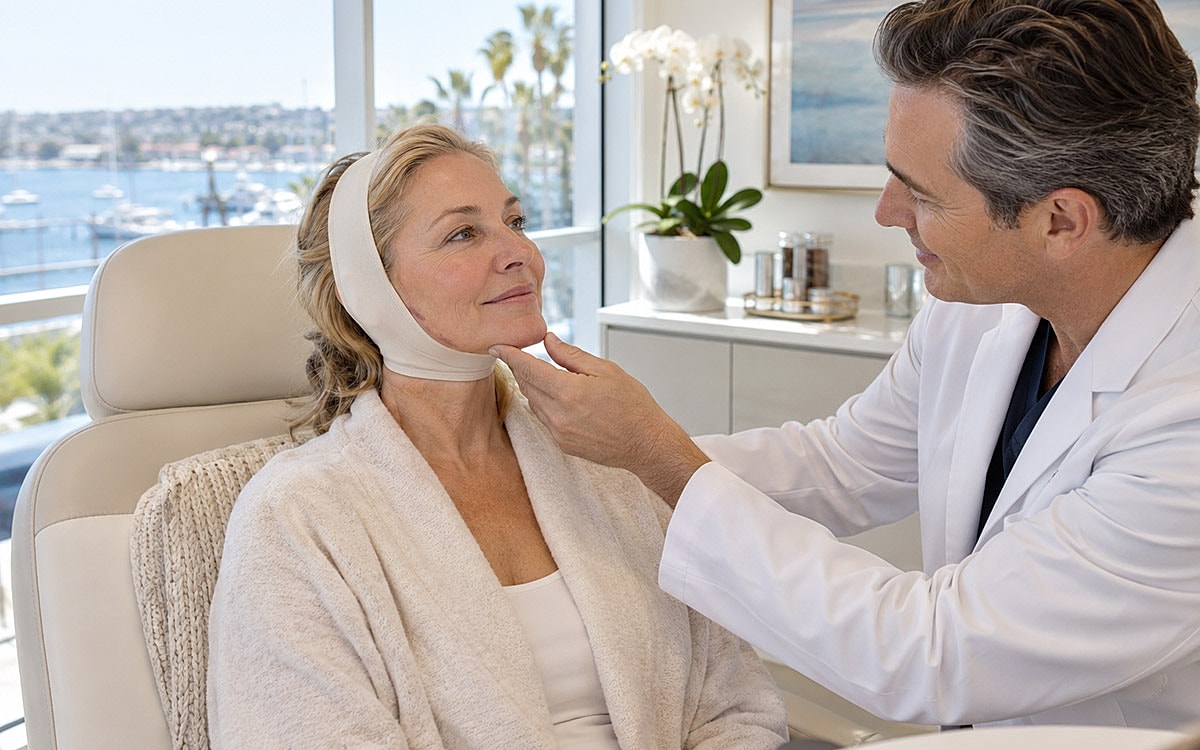
Facelift recovery follows a predictable shape. Swelling and bruising usually peak around day three or four, sutures come out somewhere between week one and week three, and most people are back at work by about two weeks. Exercise clearance typically arrives around six weeks. Tightness, numbness, and scar maturation keep settling for months afterward.
Most people booking a facelift are not worried about the operation. They are worried about the two weeks afterward and about facelift recovery landing badly on top of a work schedule, a wedding, or a family visit that cannot move. That uncertainty is often harder than the surgery itself.
It helps to know what the stages actually look like. Board-certified plastic surgeon Dr. Siamak Agha walks patients at The One Plastic Surgery Center in Newport Beach through this timeline before surgery, because a recovery you expected feels very different from one that surprises you.
What follows is a typical, general timeline drawn from published guidance and surgical literature. Every recovery is individual, and your surgeon's instructions always take priority over anything you read online. Techniques differ, healing speeds differ, and the plan you are given is built around your anatomy.
The First 48 Hours After Surgery
Quick take: The first two days are the highest risk window and the most closely monitored. Dressings stay on, the head stays elevated, and someone should be with you.
You will feel unsteady and sleepy on day one. The American Society of Plastic Surgeons advises arranging in advance for someone to drive you home and stay with you through the first stretch.
If small drains were placed to clear fluid from under the skin, they are often removed quickly. The practice's own face surgery recovery instructions describe drains after facelift or forehead procedures being taken out within about 48 hours, with the compression dressing worn for roughly seven days.
- Sleep propped on several pillows to keep the head above the heart
- Do not shower until your surgeon confirms the incisions are sealed
- Walk short distances around the house to keep circulation moving
- Keep the dressing dry and change it as instructed
The first forty-eight hours matter most, which is why nobody should spend them alone.
Week 1 of Facelift Recovery: Dressings, Drains, and Sutures
Quick take: Bruising and swelling usually peak around day three or four, then start to retreat. A first follow-up visit typically happens within the first couple of days.
ASPS describes a check at around day two for dressing removal and incision review, with bruising and swelling reaching their height on days three and four. Most patients are off prescription pain medication within the first week.
Suture removal is not a single date. Published patient guidance places it anywhere between week one and week three, depending on which incisions are involved and how they are healing. Stitches in front of the ear often come out earlier than those hidden in the hairline.
- Days 1 to 2: follow-up visit, dressing change, drain removal if drains were used
- Days 3 to 4: peak swelling and bruising
- Days 5 to 7: pain medication usually tapers, and light housework becomes possible
- Week 1 onward: sutures begin coming out in stages
Weeks 2 and 3: Bruising Fades and Life Restarts
Quick take: This is when most people rejoin the world. Residual swelling, numbness, and a tight sensation are normal and expected at this stage.
ASPS notes that many patients return to work and light walking during the second week, while some bruising and puffiness are still visible. Makeup often becomes an option once incisions are sealed, though Mayo Clinic advises avoiding makeup and picking at scabs during the early weeks after a face lift.
Hair washing usually resumes once your surgeon clears showering. The practice's instructions recommend a gentle or baby shampoo rather than anything harsh near fresh incisions.
- Week 2: back to desk work for many patients, light walking encouraged
- Weeks 2 to 3: bruising fades from purple to yellow, then clears
- Ongoing: swelling is often asymmetric, and one side may settle faster
- Social events: plan padding into the schedule rather than counting on a fixed date
Swelling rarely resolves symmetrically, and an uneven week does not predict an uneven result.
Weeks 4 to 6: Exercise Clearance and Lymphatic Massage
Quick take: Light cardiovascular activity often resumes earlier, but full exercise clearance commonly arrives around six weeks. Timelines are set by your surgeon, not the calendar.
The practice's face recovery instructions describe light cardiovascular exercise starting after about one week, with heavy lifting, contact sports, and jogging avoided for up to six to eight weeks. The deep plane facelift page describes light exercise resuming at roughly three weeks and full activity at six.
Manual lymphatic drainage, a slow rhythmic massage technique performed by a trained therapist, is sometimes recommended during this period. A review of postoperative swelling in aesthetic surgery describes it as a mainstay of nonsurgical swelling management, while noting that facial edema after a facelift tends to peak around the seventh postoperative day and largely resolve within a month.
- Do not restart exercise on your own timeline; ask at your follow-up
- Blood pressure spikes during early exertion are a real concern
- Lymphatic massage should only be done by a therapist your surgeon approves
- Sun protection matters now: SPF 30 or higher over healing incisions
Months 3 to 12: Numbness, Tightness, and Scar Maturation
Quick take: Most of the visible change is present by three months, but scars and sensation keep evolving for up to a year.
Numbness in front of and below the ear is common and usually temporary. The great auricular nerve, which supplies sensation to the ear and upper neck, is the sensory nerve most often affected, and published data reports involvement in as many as 7 percent of cases, with most patients regaining normal sensation within a year.
Tightness follows a similar arc. It reflects tissue that has been repositioned and swelling that has not fully cleared, and it softens gradually rather than disappearing on a set date.
Scars follow the biology of wound healing. The remodeling phase of healing begins around week three and can continue for up to twelve months, with the incision reaching its maximum strength around eleven to fourteen weeks. The practice's SMAS facelift page places the settled result at roughly six months.
Does Deep Plane Facelift Recovery Differ From SMAS?
Quick take: Both techniques involve similar early recovery milestones. Published comparisons show differences in complication rates rather than dramatically different timelines.
A systematic review and meta-analysis of 21 studies and 2,896 patients inaesthetic plastic surgery compared deep plane and SMAS approaches. Patient satisfaction was high in both groups, at 94.4 percent for deep plane and 87.8 percent for SMAS.
Overall complication rates in that analysis were higher for deep plane procedures at 17.2 percent compared with 10.3 percent for SMAS techniques. The authors concluded both approaches produce durable results and that technique choice should depend on the individual patient.
One technical difference does show up in the literature. Skin necrosis, meaning loss of skin at the incision edge from poor blood supply, is reported at about 3.6 percent after subcutaneous facelifts and under 1 percent with deep plane dissection, because the deep plane approach carries the skin with its blood supply intact.
Warning Signs During Facelift Recovery
Quick take: Hematoma, a collection of blood under the skin, is the most common early complication and the one that needs immediate attention. Most occur within the first 24 hours.
A review of short-term facelift complications reports hematoma in roughly 1.8 to 2 percent of facelifts, with about 90 percent occurring in the first 24 hours. Treatment is surgical evacuation, and prompt recognition matters because a sizable collection needs to be released.
Known risk factors include systolic blood pressure above 150, male sex, aspirin or anti-inflammatory use, and smoking. Keeping blood pressure controlled in the first days is part of why rest and calm are emphasized so strongly.
Mayo Clinic advises contacting your surgeon for severe pain on one side of the face or neck within 24 hours of surgery and for shortness of breath, chest pain, or an irregular heartbeat. The practice's own instructions add increasing swelling, redness, drainage, bleeding, fever, dizziness, or vomiting to that list.
- Sudden one-sided swelling or pain that keeps worsening
- Firm tightness under the skin that feels different from general puffiness
- Fever, spreading redness, or drainage with odor
- Any breathing or chest symptom, which is an emergency
Key Takeaways
- Swelling and bruising typically peak around days three to four, then improve steadily through weeks two and three.
- Suture removal generally happens between week one and week three, and many patients return to desk work at about two weeks.
- Full exercise clearance commonly arrives near six weeks and always comes from your surgeon rather than a general timeline.
- Numbness and tightness usually resolve over months, and scar remodeling continues for up to a year.
- Hematoma is the most common early complication, usually appearing within 24 hours and requiring immediate contact with your surgical team.
Results and candidacy vary by patient. Every timeline here is typical rather than promised, and only an in-person consultation can determine whether a facelift is appropriate for you.
Planning Your Facelift Recovery Realistically
The most useful thing you can do before surgery is build a calendar with room in it. Assume roughly two weeks before you look presentable at work, six weeks before exercise, and several months before the result truly settles.
The second most useful thing is knowing which symptoms deserve a phone call. Hematoma is uncommon, but it is time sensitive, and no surgical team would rather you waited politely until morning.
Ready to find out whether a facelift is right for you? Schedule a consultation with board-certified plastic surgeon Dr. Siamak Agha at The One Plastic Surgery Center in Newport Beach to discuss facelift techniques, your goals, and a recovery plan that fits your life.
Frequently Asked Questions
How long does facelift swelling last?
Swelling usually peaks around the third or fourth day and improves noticeably through weeks two and three. Published review data describes facial edema after facelift peaking around postoperative day seven and largely resolving within a month. Subtle residual swelling can persist for several months as the result settles.
When can I return to work after a facelift?
Many patients return to desk work at around two weeks, when bruising has largely faded and dressings are gone. Jobs involving physical exertion usually require longer. Your surgeon sets the timeline based on your technique, healing, and the demands of your role.
When are facelift sutures removed?
Suture removal generally occurs between week one and week three and often happens in stages. Stitches in front of the ear tend to come out earlier than those hidden within the hairline. Your surgeon decides based on how each incision is healing.
Is numbness after a facelift permanent?
Numbness around the ear and upper neck is common and usually temporary. The primary auricular nerve is the sensory nerve most often involved, reported in up to 7 percent of cases, and most patients regain normal sensation within about a year. Persistent changes should be discussed with your surgeon.
What is the most common complication after a facelift?
Hematoma, a collection of blood beneath the skin, is the most common early complication, reported in roughly 1.8 to 2 percent of facelifts. About 90 percent occur within the first 24 hours. It requires prompt surgical evacuation, so sudden one-sided pain or swelling warrants an immediate call.






