
Photo galleries answer one question well and three questions badly.
Breast augmentation before and after photos are genuinely useful for judging a surgeon's aesthetic style and consistency. They are far less useful for predicting your result, because starting anatomy, implant choice, timing after surgery, and photography conditions all vary.
Look for patients whose starting point resembles yours, and treat photos as a conversation starter rather than a preview.
Every patient looks at photos. It would be strange not to. When you are weighing an elective operation, seeing actual outcomes is the closest thing available to knowing what you are agreeing to.
The trouble is that breast augmentation before and after photos are easy to look at and hard to read. Two galleries can show equally skilled work and look entirely different. A single gallery can contain results that appear inconsistent for reasons that have nothing to do with the surgeon.
Patients at practices throughout Newport Beach arrive at consultations with saved images, which is a sensible instinct. What helps most is knowing what those images can legitimately tell you and where they quietly mislead.
This guide is how to get real information out of a photo gallery and what to do with the questions photos cannot answer.
What before and after photos genuinely show
Photos are reliable evidence of a few specific things and are worth studying carefully for them.
They show a surgeon's aesthetic sensibility. Across a gallery, you can see whether a practice tends toward subtle enhancement or dramatic change, whether results look proportionate to each patient's frame, and whether outcomes share a recognizable sensibility. That is real information about how a surgeon thinks.
They show consistency. A gallery in which results look reliably natural across many different body types tells you more than any single striking transformation.
They show technical execution, to a degree. Scar placement, symmetry, and how implants sit relative to the chest wall are visible to an attentive eye, particularly across multiple angles.
And they show range. A practice that shows only one body type or implant size reveals its limited experience.
What photos cannot tell you
Quick take: Photos cannot show your starting anatomy, the implant specifications used, how long after surgery the image was taken, or how that patient's tissue behaved during healing.
Four hidden variables shape every after photo, and none is usually labeled.
Starting anatomy. Breast tissue volume, skin elasticity, chest wall shape, rib cage width, existing asymmetry, and nipple position all determine what is achievable. Two patients receiving identical implants can finish looking quite different because they started differently.
Implant specifications. Volume, profile, shape, material, and placement relative to the chest muscle all change the outcome. A result you admire may involve choices that would not suit your frame.
Timing. This variable is the most commonly misread variable. An image taken at six weeks looks different from the same patient at six months, because implants continue settling and swelling continues resolving well beyond the early weeks. Galleries rarely state the interval.
Photography conditions. Lighting, camera angle, distance, posture, and even how a patient is standing meaningfully change the apparent result. Reputable practices standardize these conditions precisely so comparisons are fair, which is itself a signal worth noticing.
The variable that changes a photo most is often just how long after surgery it was taken.
How to actually use a gallery
Quick take: Look for patients whose starting point resembles yours, study multiple angles, and pay attention to consistency rather than the single most dramatic result.
A practical method:
Find your starting point, not your goal. Scan for pre-operative photos that resemble your anatomy in tissue volume, frame, and existing shape. The after photo attached to a similar before photo is far more informative than the most appealing after photo in the gallery.
Look at multiple angles. Front, oblique, and profile views together tell you about projection, upper pole fullness, and how implants sit. A gallery showing only one angle is showing you less than it appears to.
Notice the unremarkable results. The most useful images are often the least dramatic ones, where the outcome looks natural enough that you have to compare carefully to see the change. That is difficult to achieve.
Assess consistency across the gallery. Reliable quality across many patients matters more than one exceptional outcome.
Note what is absent. No revision cases, no complex anatomy, and only one body type all suggest a curated view rather than a representative one.
Why your result will be your own
The honest limitation of any gallery is that it shows other people.
Your outcome depends on your tissue, your frame, your healing, the implant chosen for you specifically, and surgical decisions made based on your anatomy. Two patients with the same implants and the same surgeon can finish with meaningfully different results, and neither is a failure.
This variability is why a consultation cannot be replaced by research. During an in-person evaluation, a surgeon measures, assesses tissue quality and skin elasticity, and discusses what your particular anatomy will support. Some patients learn that the look they saved is achievable. Others learn it would require implant sizing that their tissue would not comfortably accommodate, which is a conversation better had beforehand.
Patients considering breast augmentation at The One Plastic Surgery Center in Newport Beach are encouraged to bring saved photos to consultation, because images communicate aesthetic preference far more precisely than words like "natural" or "not too big," which mean different things to different people.
Bringing photos to your consultation
Photos are most valuable as a communication tool, and using them well is straightforward.
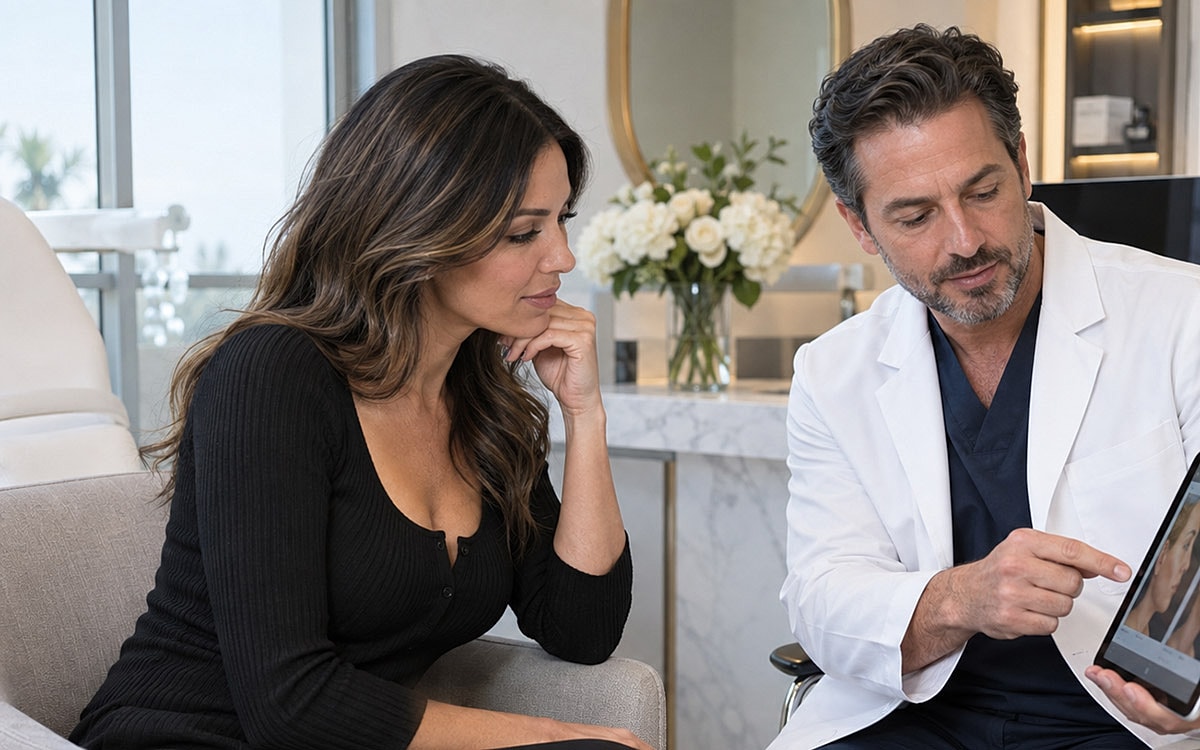
Bring several images rather than one, including results you like and results you do not, since the second set is often more informative. Be prepared to say what specifically appeals to you about each, whether that is upper pole fullness, overall proportion, or how the result looks in clothing.
Then listen to the response. A surgeon who reviews your saved images against your actual anatomy and explains what is and is not realistic is doing exactly the right thing, even when the answer is not what you hoped. Someone who agrees with everything is not evaluating you.
Board-certified plastic surgeon Dr. Siamak Agha and the team at The One Plastic Surgery Center approach the procedure as a joint decision, working through implant options, placement, and what your tissue will support before anything is scheduled.
Setting expectations you can live with
The patients who are happiest a year after surgery are consistently the ones who understood what they were getting beforehand. They are not the ones who got the most dramatic result, nor the ones with the highest expectations.
Photos help build that understanding when you read them carefully, but they can mislead you if you treat them as a preview. Use them to learn how a surgeon thinks and to communicate what you want. Then let an in-person evaluation tell you what is realistic for you.
Ready to find out whether breast augmentation is right for you? Schedule a consultation with board-certified plastic surgeon Dr. Siamak Agha at The One Plastic Surgery Center in Newport Beach, bring the photos you have saved, and get an honest assessment of what your anatomy will support.
Frequently asked questions
How reliable are breast augmentation before and after photos? They reliably show a surgeon's aesthetic style, consistency, and technical execution. They are unreliable for predicting your result, because starting anatomy, implant specifications, time since surgery, and photography conditions all vary and are rarely disclosed.
How long after surgery are after photos usually taken? Galleries often do not disclose this information, which is a meaningful limitation. Implants continue settling and swelling continues resolving for months, so an image at six weeks looks different from the same patient at six months. Ask a practice directly when their photos were taken.
Should I bring photos to my consultation? Yes. Images communicate aesthetic preference far more precisely than descriptive words. Bring several results, both those you like and those you do not, and be ready to explain what you like about each.
Why do results differ between patients with the same implants? Because starting anatomy differs. Tissue volume, skin elasticity, chest wall shape, frame, and healing response all influence the outcome. Identical implants in different patients produce different results, and that is expected rather than a problem.
What should make me skeptical of a photo gallery? Only one body type was represented, only one camera angle, inconsistent lighting or posture between before and after images, and no acknowledgment of timing. Standardized photography conditions are a sign a practice is presenting results fairly.
Medical disclaimer - This article is for informational purposes only and is not a substitute for professional medical advice, diagnosis, or treatment. Photographs depict individual patients and do not predict or guarantee results for any other patient. Results and candidacy vary by individual, and an in-person consultation with a board-certified plastic surgeon is required to determine whether a procedure is appropriate for you.