
The Hidden Cost of an Ozempic Body
Medically Reviewed by Dr. Siamak Agha, MD, PhD, FACS
“I wanted to lose 10 pounds, and so I tried Mounjaro, but I got a pancake flat butt. I had to make my own padding in my butt.”
That’s how one of Dr. Agha’s patients, who flew in from Oregon, described what happened after a short course of weekly Mounjaro injections.
Take note: She wasn’t trying to transform her body; she just wanted to lose a little weight. She lost 10 to 12 pounds in seven weeks!
But months after stopping the medication, her buttocks kept changing shape, growing flatter even as she continued working out vigorously. She even started wearing padded underwear to compensate.
This is the Ozempic butt in a GLP-1 body. And at The One Plastic Surgery in Newport Beach, we’re seeing more of it every month.
In this article, we'll explain how GLP-1 weight loss can change the shape of the buttocks, what research says about muscle loss on these medications, and how Dr. Agha's lower body lift restored this patient's shape, with results that have held for two years.
Key Takeaways
- A GLP-1 body can involve muscle, not just loose skin. In body composition substudies, approximately 25% to 35% of the weight lost was lean mass, which includes muscle but also other tissues.
- The changes can show up even after modest weight loss. This patient noticed her buttocks flattening after losing about 10 to 12 pounds on Mounjaro in seven weeks.
- A lower body lift can restore shape with the patient's own tissue. Dr. Agha combined thigh lifts, a buttock lift, a lower back fat flap and fat transfer, with no implants.
- The patient’s results were holding two years later. Dr. Agha has performed 566 lower body lifts through 2025.
What Is Ozempic Butt and Why Does It Happen?
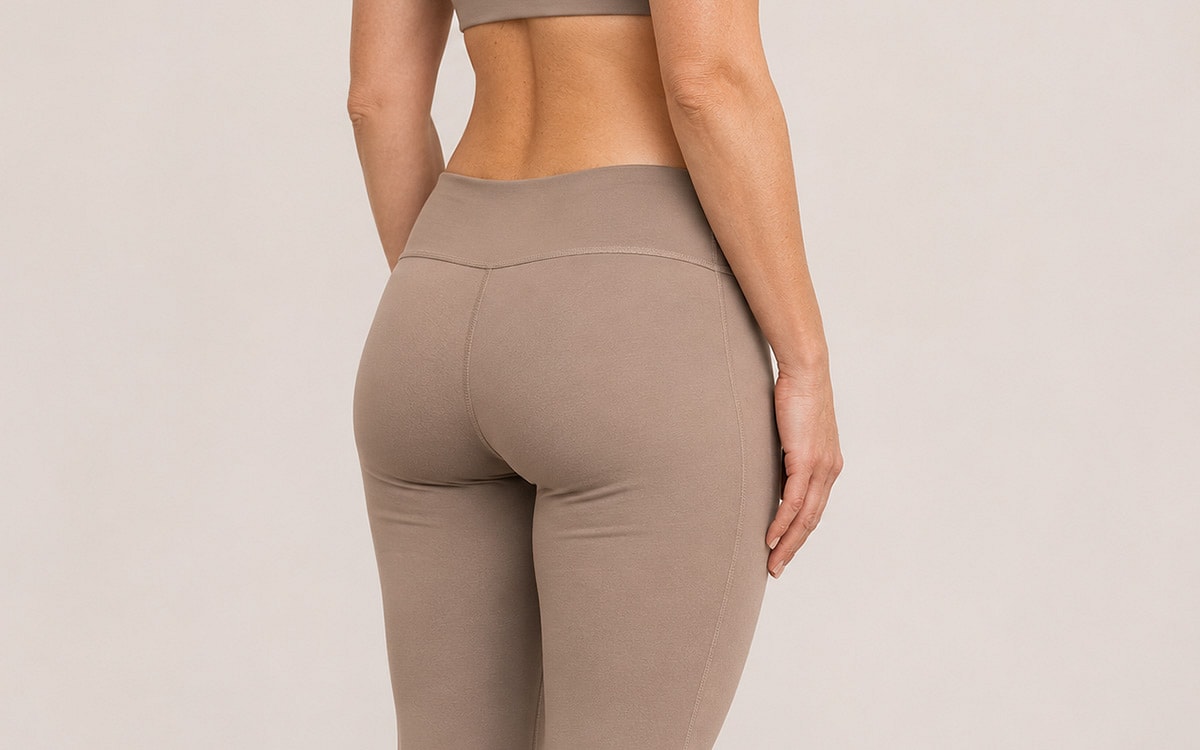
Ozempic butt describes flattening, deflation or sagging of the buttocks after weight loss with medications such as Ozempic and Mounjaro. It can result from a loss of fat and muscle volume, not only loose skin.
The shape of the buttocks depends on several layers of tissue working together:
- Fat: determines fullness and roundness. Weight loss can't be directed to specific areas, so the buttocks can lose volume along with the rest of the body.
- Muscle: gives the buttocks their underlying shape and projection. When muscle volume drops, the area can look flatter, even in someone who exercises regularly.
- Skin: has to retract as the underlying tissue shrinks. When weight loss is rapid, skin can lag behind, leaving laxity and wrinkling.
Most conversations about Ozempic body focus on loose or sagging skin, which is real and well understood. But Dr. Agha also sees something that gets less attention: weight loss on GLP-1 medications can involve a loss of muscle volume alongside fat.
“Mounjaro cannibalizes muscle,” Dr. Agha explained during her consultation. “This is one of the problems of using these wonderful weight loss medications. It actually causes muscle loss at the same time. And we are seeing more and more patients who’ve lost weight and muscle as a result.” He notes the same pattern can show up in the triceps, not just the buttocks.
Dr. Agha's observation lines up with what researchers have found, with some nuance. In the STEP 1 body composition substudy, participants taking semaglutide lost 15% of their body weight and 9.7% of their lean mass, corresponding to approximately 35% of weight lost as lean mass based on the reported baseline composition. In the SURMOUNT-1 substudy, approximately 25% of weight lost on tirzepatide was lean mass. Lean mass includes muscle, but also water and other tissue. The tirzepatide and placebo groups lost similar proportions of fat and lean mass.
In this patient's case, Dr. Agha observed a considerable loss of buttock muscle volume despite her working out vigorously. Her thighs showed skin wrinkling from the weight loss, and she was thin, so there wasn't much fat to work with.
What’s curious is how little weight she actually lost. She wasn’t someone who dropped 80 or 100 pounds — she lost only about 10. Yet her buttocks visibly deflated, flattening a shape that years of exercise alone couldn’t restore.
So if you’re wondering about Mounjaro body or Ozempic butt changes, that’s one thing you need to understand: you don’t need dramatic weight loss for your proportions to change. Resistance training and adequate protein can help preserve muscle, but exercise cannot directly lift sagging tissues or selectively restore lost fat.
A 2025 joint advisory from four medical and nutrition organizations recommends adequate protein and resistance training during GLP-1 treatment.
How Did Dr. Agha Restore Her Shape?
For this patient, Dr. Agha performed a customized High-Definition Lower Body Lift™ without a full tummy tuck because she’d already had abdominal surgery elsewhere and her abdominal contour did not require a full tummy tuck. His approach involves comprehensive lifting and reshaping of the lower body, tailored to the patient’s anatomy. He used portions of her previous tummy tuck incisions to complete the front thigh lift.
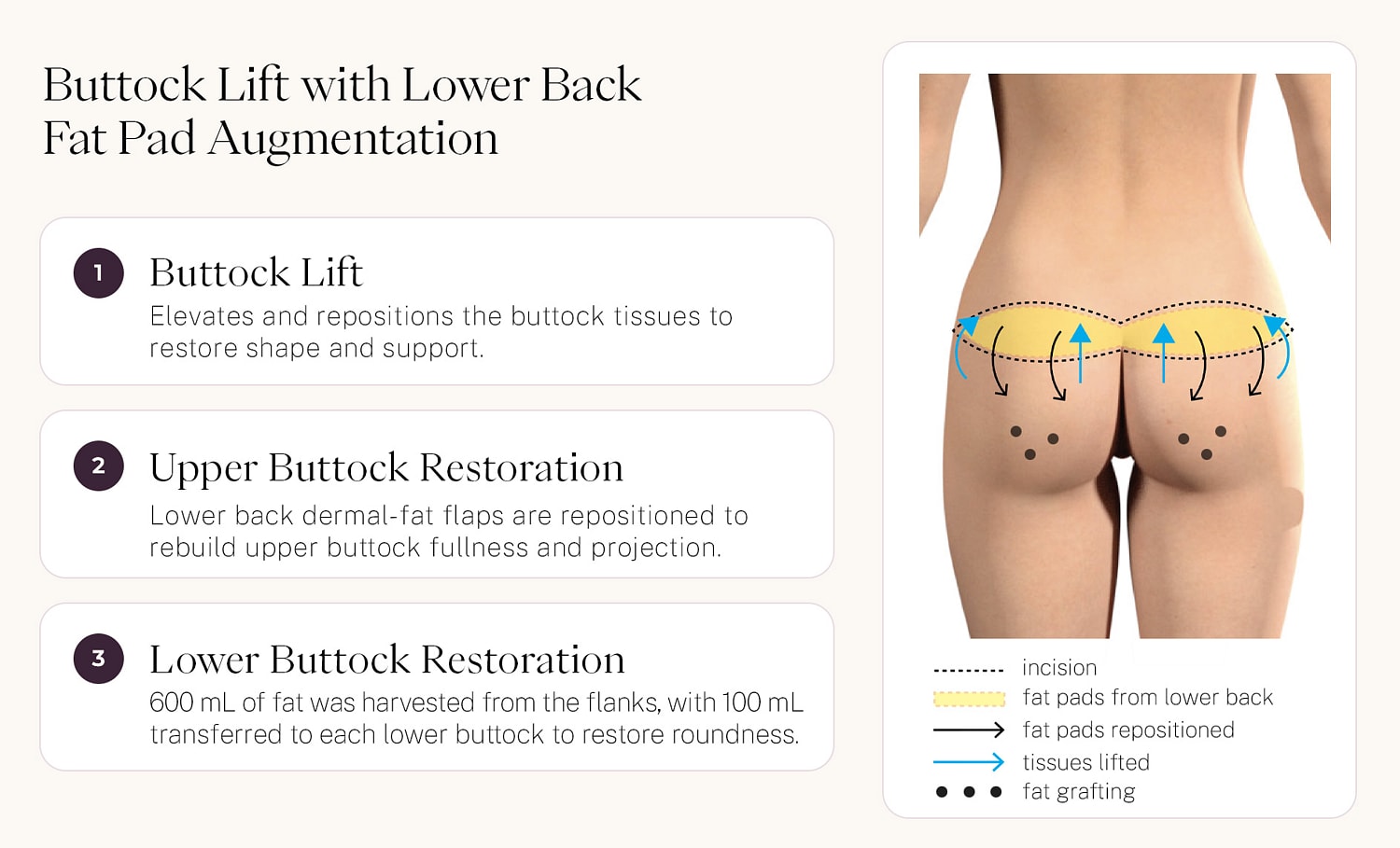
The patient’s procedure combined a front, outer, and inner thigh lift with a buttock lift and buttock augmentation. To restore fullness without implants, Dr. Agha combined two techniques:
Upper buttock restoration: Dr. Agha repositioned her lower back dermal-fat flaps over the gluteal muscle to restore fullness and projection. These flaps retain an attached blood supply.
Lower buttock restoration: Dr. Agha liposuctioned 600 mL of fat from her flanks and transferred 100 mL to each side of her lower buttocks to restore roundness.
The combination of buttock lifting and buttock augmentation restored contour using her own tissue, without replacing the muscle itself.
Explore her Surgery Journal for a closer look at her surgical journey and the techniques Dr. Agha used to restore her lower body shape and proportions.
He also performed an inner thigh lift, which is one of the more technically demanding procedures Dr. Agha performs.
Why Is the Inner Thigh Lift So Hard to Get Right?
The inner thigh lift is one of the hardest procedures Dr. Agha performs because the scar can migrate downward over time.
For this patient, the incision sits at the junction between the labia and upper inner thigh (the groin crease), and that scar has a tendency to migrate downward over time if it isn’t secured properly. Dr. Agha removed approximately one and a half to two inches of excess skin, lifted the upper inner thigh and reconstructed the groin crease.
To combat this, Dr. Agha places extensive anchoring sutures and intentionally overcorrects the lift so that, even with some natural settling, the final scar is more likely to stay hidden in the groin crease rather than drifting onto the visible thigh skin.
The procedure is so difficult that he revises five to six cases like this every year for patients whose inner thigh lifts performed elsewhere didn’t hold.
Learn more about Dr. Agha’s thigh lift techniques.
Ozempic Butt Before and After: How Long Do the Results Last?
In this patient's case, her results were still holding at two years. Dr. Agha noted that some volume settled early on, but most of the correction was retained.
| Timeline | Patient Results |
|---|---|
| 4 weeks | The patient’s incisions healed well without issues. They were well hidden beneath a thong, and she was eager to shop for swimwear again. |
| 4 months | The before-and-after photographs show a lifted buttock contour with restored fullness and roundness. |
| 5 months | Most of the buttock correction was retained: the upper buttock filled with her own lower back flap and the lower buttock with transferred fat. |
| 2 years | The patient maintained a lifted silhouette. The scar placed at the junction of her lower back and upper buttock was almost invisible. |
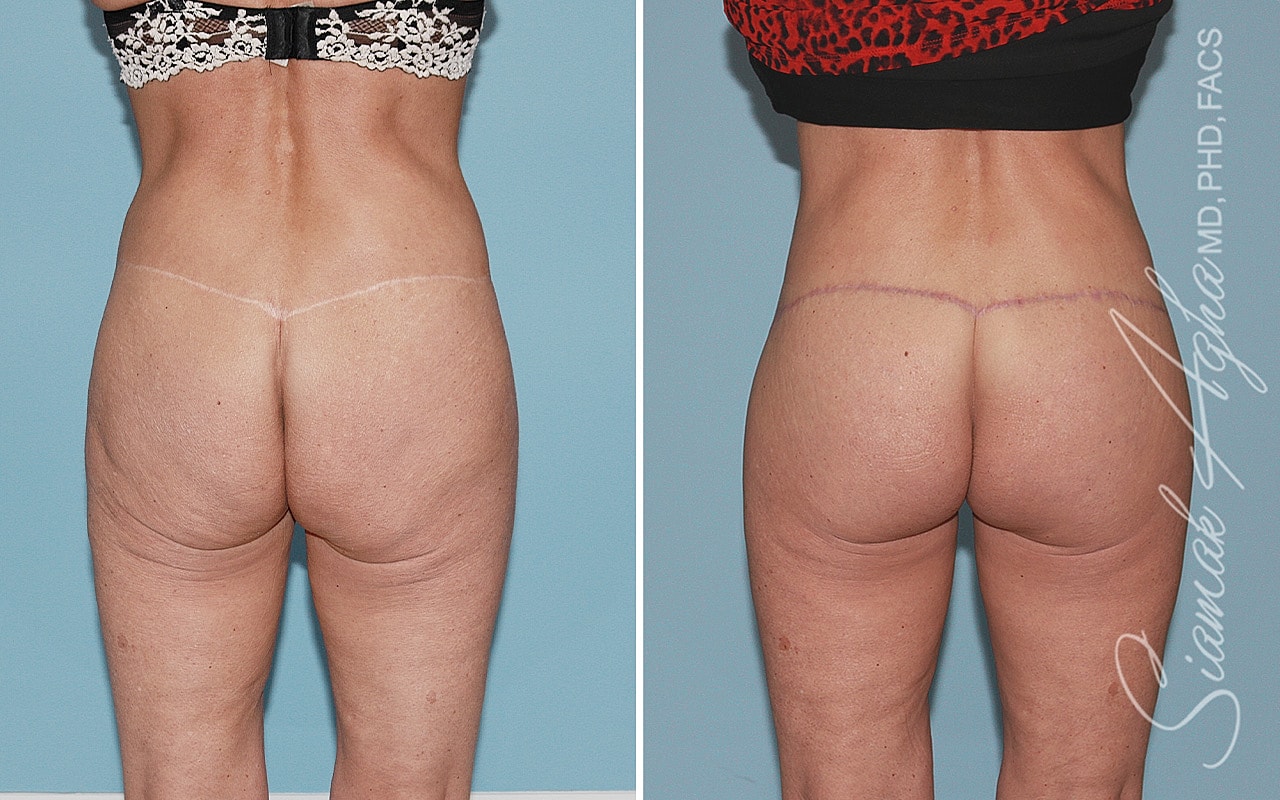
View her complete lower body lift before and after photo gallery.
“What she has retained is going to be permanent,” Dr. Agha noted of the augmentation, which combines a lower back fat flap for upper buttock fullness with fat transfer for the lower buttock. Surviving transferred fat and repositioned tissue can provide long-lasting volume, although aging and weight changes can affect the result.
Watch her two-year postoperative follow-up to see how well her restored buttock shape and lower body contours have been maintained over time.
These are the results of one patient; healing and long-term outcomes vary.
Why Does Surgeon Experience Matter for a Lower Body Lift?
Lower body lifts and buttock augmentation after GLP-1-related weight and muscle loss are technically demanding procedures.
Through 2025, Dr. Siamak Agha, MD, PhD, FACS, had performed 566 lower body lifts, 577 buttock lifts, 842 buttock augmentations and 614 thigh lifts. This experience is valuable when several techniques must be combined to restore shape in a patient with limited available fat.
Needless to say, your surgeon’s experience matters in the result, not just the immediate outcome, but also in years to come.
What Can You Do About GLP-1 Body Changes?
If weight loss on Ozempic, Mounjaro, or another GLP-1 medication has left you with flattened, sagging, or deflated areas that exercise hasn’t been able to fix, you’re not alone. Losing weight quickly can change both fat and muscle, and Dr. Agha has developed specific, refined techniques to address these contour changes.
Schedule a consultation with Dr. Agha to discuss whether a Lower Body Lift or buttock restoration procedure is right for your body and your goals.
Frequently Asked Questions
Does Ozempic or Mounjaro cause muscle loss?
GLP-1 weight loss can include loss of lean mass, which includes muscle. Body composition substudies of semaglutide and tirzepatide found approximately 35% and 25%, respectively, of weight lost was lean mass. Lean mass also includes water and other tissue, and resistance training and adequate protein can help preserve muscle.
Can you get an Ozempic butt from losing only 10 pounds?
It can happen, according to one of Dr. Agha's patients. She lost about 10 to 12 pounds in seven weeks on Mounjaro, and her buttocks kept flattening even after she stopped the medication. Dr. Agha attributed this in part to muscle loss.
Can exercise fix a flat butt after GLP-1 weight loss?
Exercise, especially resistance training, can help preserve muscle during weight loss. In this patient's case, though, vigorous workouts hadn't restored her shape, which is what led her to Dr. Agha. He rebuilt her volume using her own tissue, placed over the muscle.
How is a lower body lift different from a BBL?
A Brazilian butt lift (BBL) adds volume to the buttocks by transferring fat taken from elsewhere through liposuction. A High-Definition Lower Body Lift™ lifts and reshapes the lower body. Because this patient needed lifting and volume, Dr. Agha combined thigh lifts and a buttock lift with augmentation from her lower back fat flap and fat transfer.
Will a lower body lift leave visible scars?
Dr. Agha plans incisions to help conceal scars beneath a thong or bikini. In this patient's case, the scars sat in the groin crease and at the junction of her lower back and upper buttock. At two years, he described them as almost invisible. Scar healing varies between patients.
Patient Journey and Clinical Resources
Full patient journey – YouTube
Two-year postoperative follow-up – Instagram
Lower body lift before-and-after photos – Patient 89
Surgery Journal: High-Definition Lower Body Lift™ Following GLP-1 Weight Loss
Scientific References
Look et al. (2025). SURMOUNT-1 body composition substudy. Diabetes, Obesity and Metabolism.
Nutritional priorities to support GLP-1 therapy for obesity (2025 joint advisory).