


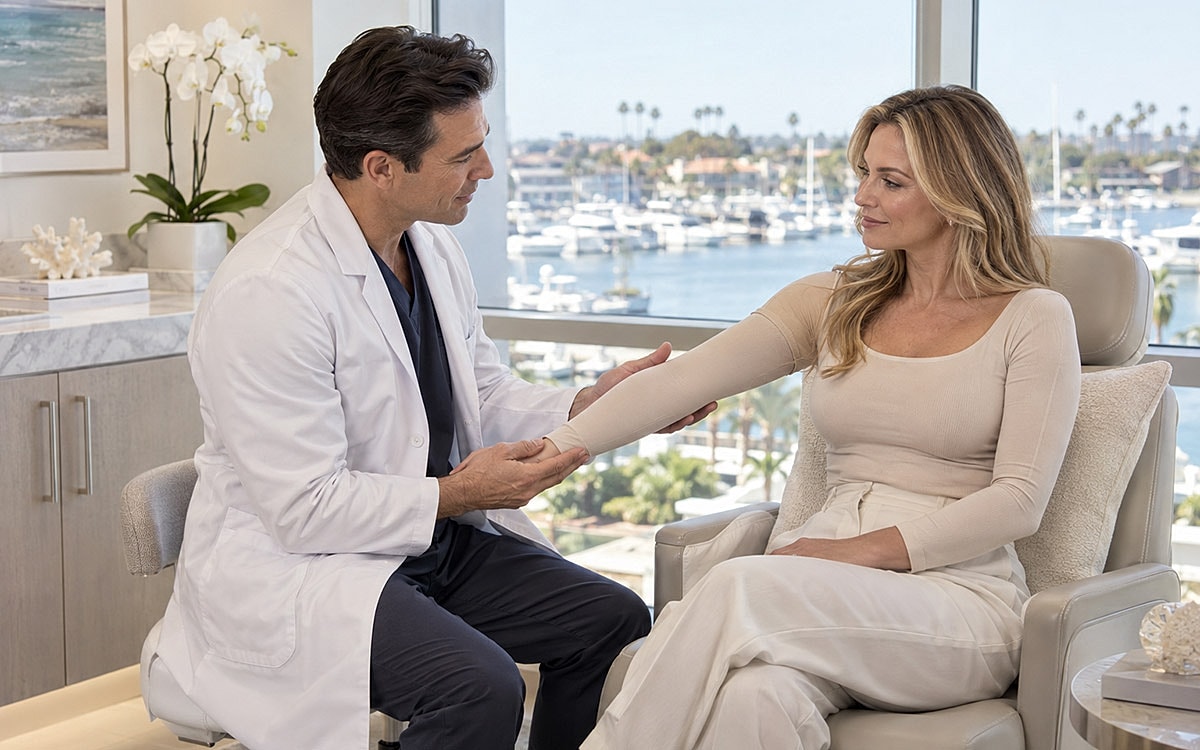
Arm lift recovery is short on downtime and long on patience. Most people manage light desk work within two to three weeks and light cardio around four weeks, with full activity closer to eight. The part that takes real time is the scar along the inner arm, which keeps changing for a year or more before it settles.
Most people planning an arm lift ask how long recovery takes and expect one number. The honest answer has two parts. Functional recovery, meaning sleeping comfortably, working, driving, and lifting a grocery bag, resolves within weeks. Scar recovery takes about a year.
Understanding that split changes how the whole experience feels. Patients who expect the arm to look finished at six weeks get discouraged. Patients who know the scar has a long maturation ahead of it tend to judge their results at the right time.
At The One Plastic Surgery Center in Newport Beach, board-certified plastic surgeon Dr. Siamak Agha plans brachioplasty around scar placement as carefully as around skin removal, because the scar is what patients live with. What follows is a realistic account of arm lift recovery from the first evening through the first year, including what changes for patients coming out of major weight loss.
Why Arm Lift Recovery Is Measured in Two Timelines
Arm lift recovery runs on two clocks at once. The first is short: swelling, bruising, and restricted movement that resolve over roughly four to six weeks. The second is long: a scar along the inner arm that keeps remodeling for twelve to eighteen months.
The American Society of Plastic Surgeons is candid that arm lift scars are among the thickest in plastic surgery, because the arm never stops moving and the closure sits under constant low-grade tension. That is why so much of aftercare is about keeping tension off the incision.
Knowing this reframes the middle weeks. When the arm feels normal but the line still looks red and firm, nothing has gone wrong.
The First Week: Elevation, Wraps, and Protecting the Closure
Brachioplasty is usually an outpatient operation of roughly two to three hours, and most patients go home the same day. The first week is spent keeping the arms elevated, keeping the dressings intact, and moving the elbows and shoulders gently without pulling on the closure.
Support in this early phase is often a wrap rather than a sleeve. ASPS notes that after surgery the arms may be wrapped in an elastic bandage or compression garment to minimize swelling.
The practice's arm lift page describes sterile dressings supported by elastic bandages running from wrist to armpit, which avoids the tension a pull-on sleeve can create over a fresh incision. Drains are frequently not needed, and StatPearls notes that closed suction drain use in brachioplasty is surgeon dependent and does not reliably prevent seroma.
Elevation does most of the work. Propping both arms on pillows above heart level, day and night, is the most effective thing a patient can do in week one, because gravity is otherwise pulling fluid into the hands and forearms.
Expect your hands to feel puffy and your arms heavy. Expect to sleep on your back and to need help with anything above shoulder height.
Weeks Two and Three: Driving, Desk Work, and Ordinary Motion
Most patients return to sedentary work between two and three weeks after brachioplasty, and driving usually becomes reasonable around the same point. StatPearls advises avoiding strenuous activity and driving for at least two weeks. ASPS notes that some people manage work from home within days, though that depends entirely on the job.
Driving is a judgment call with a clear test. You need full, pain-free motion at the shoulder and elbow, enough strength to control the wheel in an emergency, and no sedating medication in your system. If anyone is missing, you are not ready.
Sutures come out, or dissolve, in this window. ASPS describes incisions closed with absorbable or removable sutures within one to two weeks, and the practice schedules an early follow-up at around five days to check the closure.
This period is also when compression usually transitions. Once the incisions are sealed, a sleeve can replace the wrap. Putting a sleeve on too early risks dragging the closure, which is why the practice specifically advises waiting until the incision has sealed.
Weeks Four to Eight: Compression, Cardio, and Upper-Body Strength
Compression garments are typically worn for around four to six weeks, light cardiovascular exercise often resumes near four weeks, and full activity, including upper-body resistance training, generally waits until about eight weeks. The order matters more than the dates, because the arms carry loads differently than the legs do.
ASPS puts compression sleeves at four to six weeks, and StatPearls describes roughly four weeks of compression with strenuous activity restricted early. The practice's body recovery instructions place light cardiovascular exercise after the early healing window and heavy lifting later still.
Rebuild in a sensible order. Walking and stationary cycling first, since neither loads the arms.
Then lower-body resistance work, then light upper-body movements in a short range, and last, anything that stretches the arm overhead or loads it near the end range.
The reason is mechanical. Overhead and end-range movements put direct tension across a closure that is still gaining strength, and that tension is what widens the scar.
The Inner Arm Scar and What Actually Improves It
The scar is the trade patients make for the shape, and it is the part of arm lift recovery that rewards patience and consistency. Surgeons place it where it hides best, then patients spend the next year managing it with compression, silicone, massage, and sun protection.
Placement is a surgical decision made before the first incision. ASPS describes incisions along the inner arm or the back of the arm, running from the underarm toward the elbow, with the pattern chosen by how much skin needs to come out. At this practice, Dr. Agha positions the incision in the shadow area between the front and back of the arm rather than in the traditional groove, so the line is less visible in everyday arm positions.
Once the incision is fully healed, the evidence for silicone is reasonably strong. The NCBI Textbook on Scar Management describes silicone gel applied to healed incisions for about three months, worn roughly twelve hours a day, reducing scar stiffness and redness. StatPearls adds massage, sun protection, and corticosteroid injection when a scar starts to thicken.
The scar is the trade. Placement is surgical, but maturation is a year of patient, consistent aftercare.
Swelling, Seroma, and Healing at the Axilla
Two areas deserve extra attention during arm lift recovery: fluid collection along the incision and wound healing where the incision crosses the armpit. Both are common enough to expect and manageable when caught early.
A literature review of more than a thousand brachioplasty patients found complications in about 29 percent of cases, most of them minor. Hypertrophic scarring led at roughly 11 percent, followed by seroma or lymphedema near 7 percent, delayed healing near 6 percent, and infection around 3 percent.
The axilla is the hardest area to heal. It is mobile, moist, and creased, which is why small wound separations there are more common than elsewhere along the incision and are usually treated with local wound care rather than more surgery.
Lymphatic drainage from the arm passes through this region, so swelling in the hand or forearm that keeps increasing deserves a call rather than a wait. Sensory changes are common too: StatPearls identifies the medial antebrachial cutaneous nerve, which supplies feeling to the inner forearm, as the most frequent sensory complication.
Contact the office promptly if you notice any of the following:
- Fever, spreading redness, or foul drainage from an incision
- A soft, sloshing fullness that appears or grows after things had been improving
- An incision that separates, or skin along it that turns dark
- Swelling in one hand or forearm that keeps increasing rather than settling
- New numbness, burning, or weakness that worsens instead of improving
Arm Lift Recovery After Major Weight Loss
Patients coming out of bariatric surgery or substantial medical weight loss are a distinct group, and their arm lift recovery reflects that. ASPS notes that brachioplasty is generally preferred over liposuction alone when skin laxity is the dominant problem, which is nearly always the case after a large loss.
Skin excess in these patients often extends past the arm and onto the lateral chest, so the operation is larger. The practice's post-bariatric arm lift page describes extended and L-shaped brachioplasty approaches that address armpit sagging along with the arm, sometimes combined with an upper body lift. A longer incision means more surface area to protect and more scar to manage.
Nutrition is even more important here. Protein, iron, vitamin B12, and vitamin D are commonly low after bariatric surgery, and healing depends on them, which is why surgeons want weight stable and labs in range first.
Expectations should be set accordingly. Contour improvement after massive weight loss is often dramatic, and the scars are often longer and slower to fade. Both are true at once, and a consultation is where that trade gets discussed in detail.
Key Takeaways
- Arm lift recovery has a short functional phase of about four to six weeks and a long scar phase of twelve to eighteen months.
- Elevation above heart level and gentle wrap support in week one do more for swelling than anything else.
- Most patients manage desk work and driving around for two to three weeks, light cardio near four weeks, and upper-body training closer to eight.
- Overhead and end-range arm movements are restricted the longest because they put direct tension across the healing inner arm closure.
- Seroma and small wound separations at the armpit are the most common setbacks, and both are usually managed in the office.
Results and candidacy vary from patient to patient, and this article is educational rather than medical advice. Only an in-person consultation with a board-certified plastic surgeon can determine whether an arm lift is appropriate for you.
Planning an Arm Lift Around Your Real Life
The patients who recover most comfortably plan for both timelines. They arrange help for the first week, clear the calendar of overhead reaching, give their employer a realistic return date, and commit to scar care long after the arm feels normal.
If loose upper arm skin has been shaping what you wear, an examination will tell you far more than any general timeline can, including which incision pattern suits your anatomy.
Ready to find out whether an arm lift is right for you? Schedule a consultation with board-certified plastic surgeon Dr. Siamak Agha at The One Plastic Surgery Center in Newport Beach to discuss your goals, your options, and what recovery would look like for you.
Schedule Your Consultation
Frequently Asked Questions
How long before I can drive after an arm lift?
Most patients are advised to avoid driving for at least two weeks. Before you drive, you need pain-free shoulder and elbow motion, enough strength to control the wheel in an emergency, and no sedating pain medication in your system. Your surgeon will make the final decision.
When can I lift weights again after brachioplasty?
Light cardiovascular exercise often resumes around four weeks, while upper-body resistance training generally waits until about eight weeks. Overhead pressing, pull-ups, and heavy rows come last because they place direct tension on the healing inner arm closure, which is what tends to widen a scar.
Will the arm lift scar be very visible?
Arm lift scars are placed along the inner arm or the shadow line between the front and back of the arm, where they show the least in normal arm positions. They are typically red and firm for months and continue maturing for twelve to eighteen months. Scar appearance varies considerably between individuals.
Do I need drains after an arm lift?
Drain use varies by surgeon and by how much tissue is removed. Current evidence suggests drains do not reliably prevent seroma in brachioplasty, and many arm lifts are performed without them, using dressings and elastic support instead. Your surgeon will explain the plan for your specific procedure.
Is recovery different after major weight loss?
Often yes. Skin excess after a large weight loss frequently extends onto the lateral chest, so the operation and the incision are longer. Nutritional status also affects healing, which is why surgeons typically want a stable weight and normal lab values before scheduling surgery.






