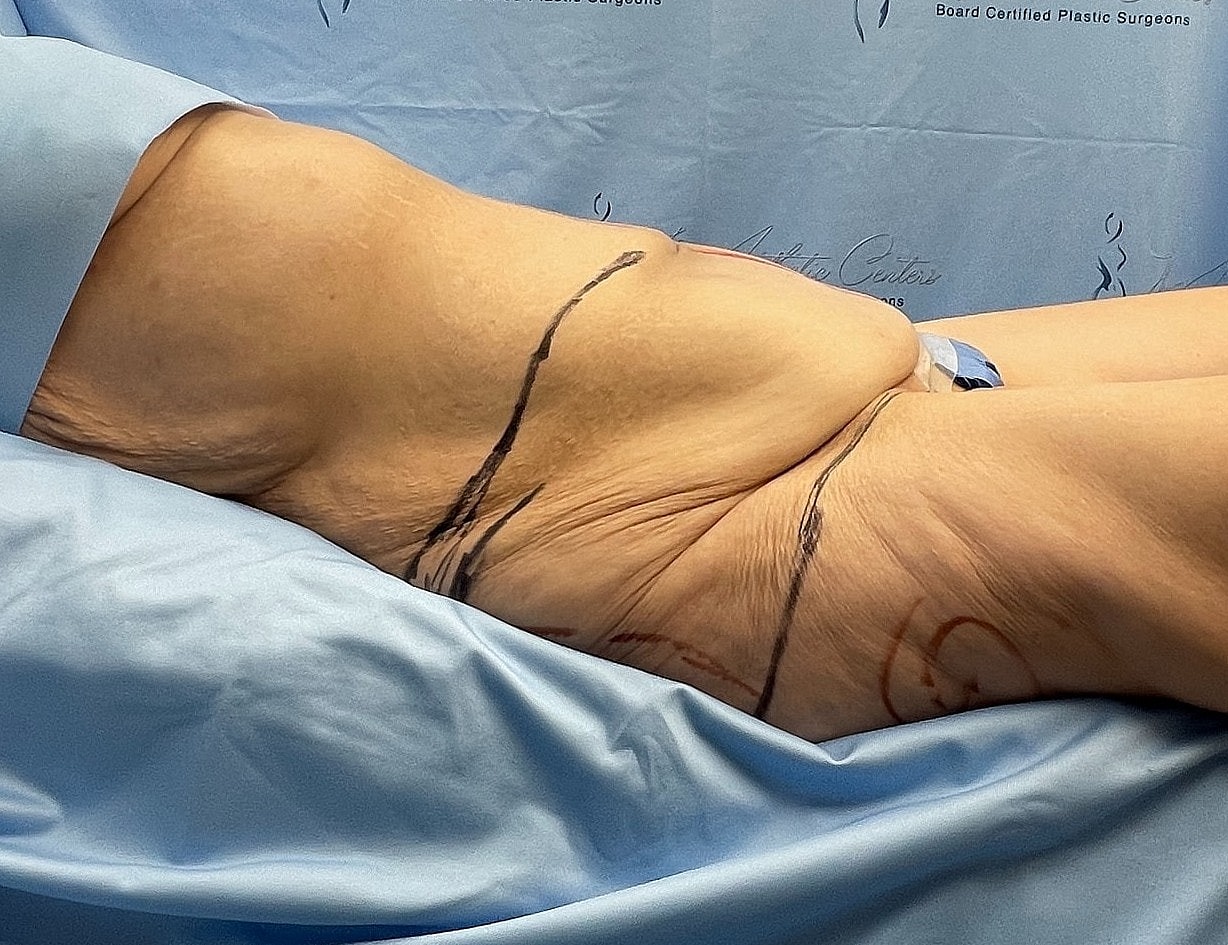
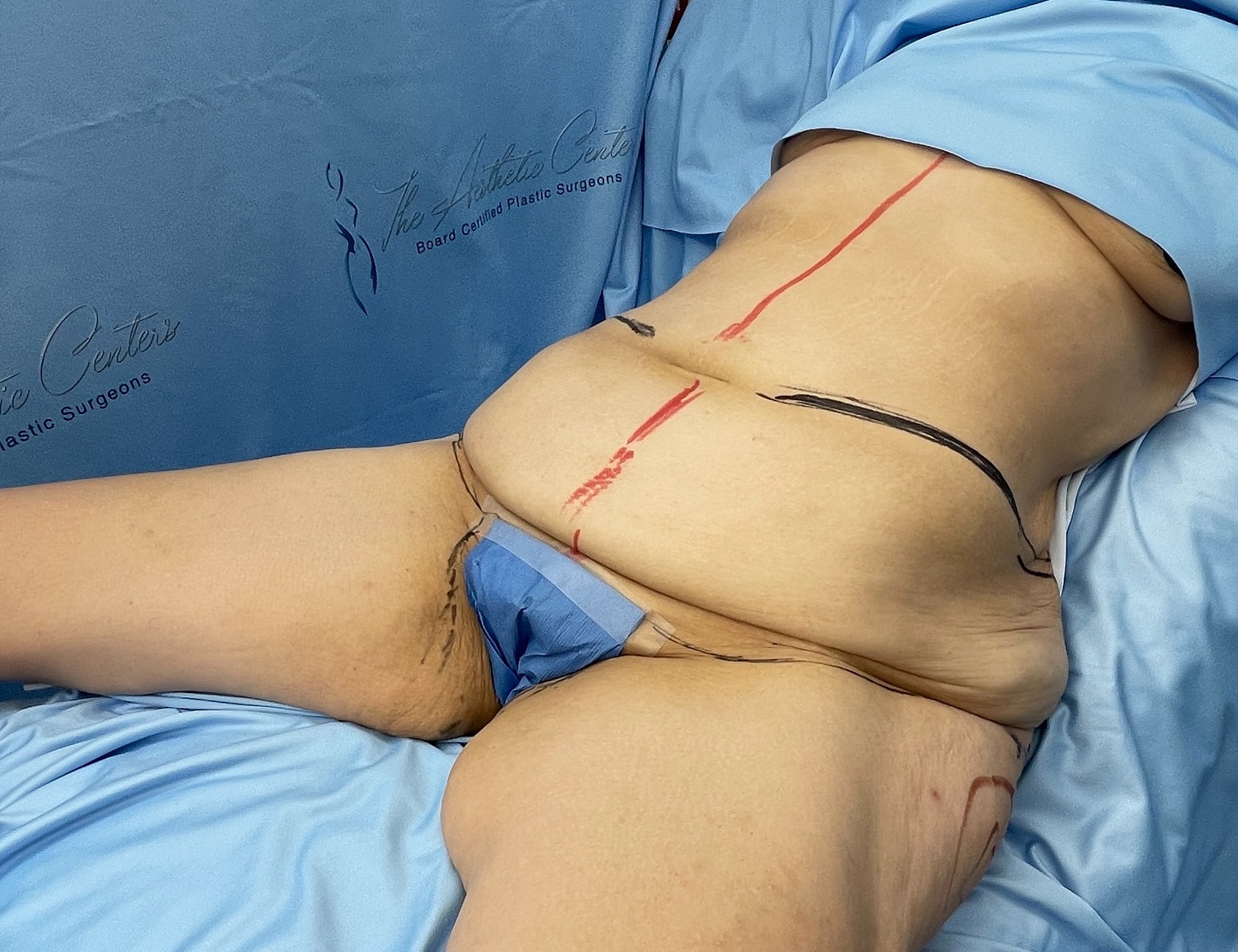
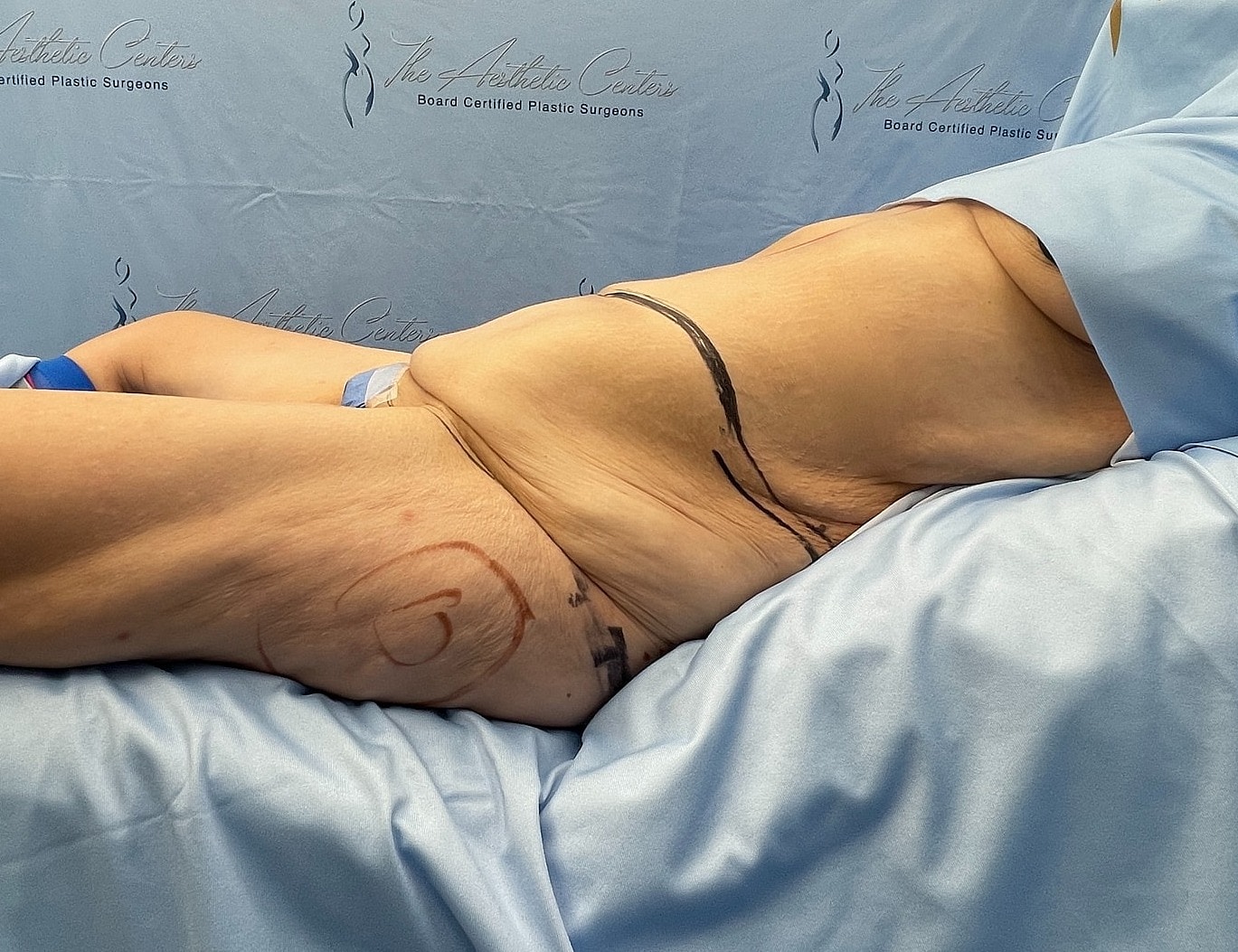
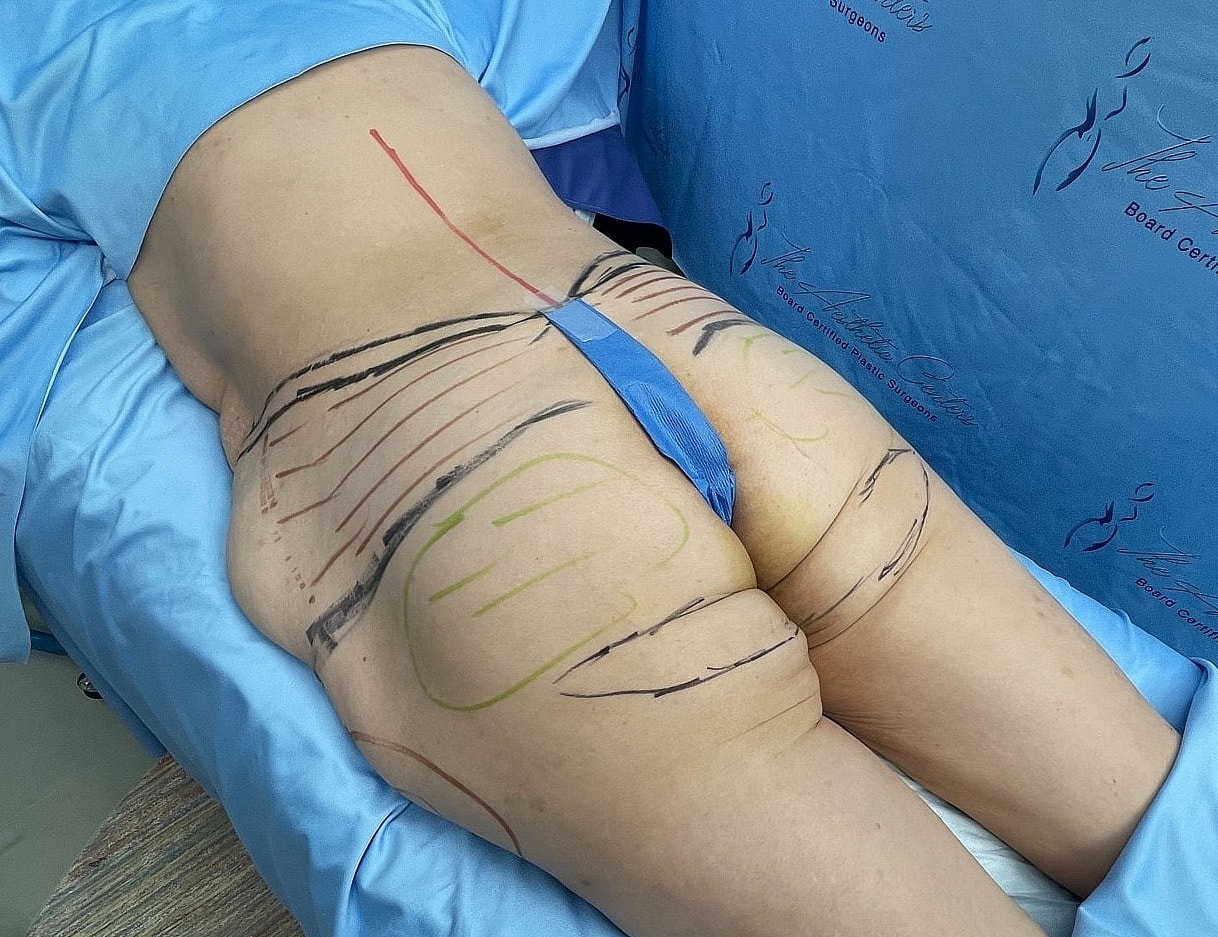
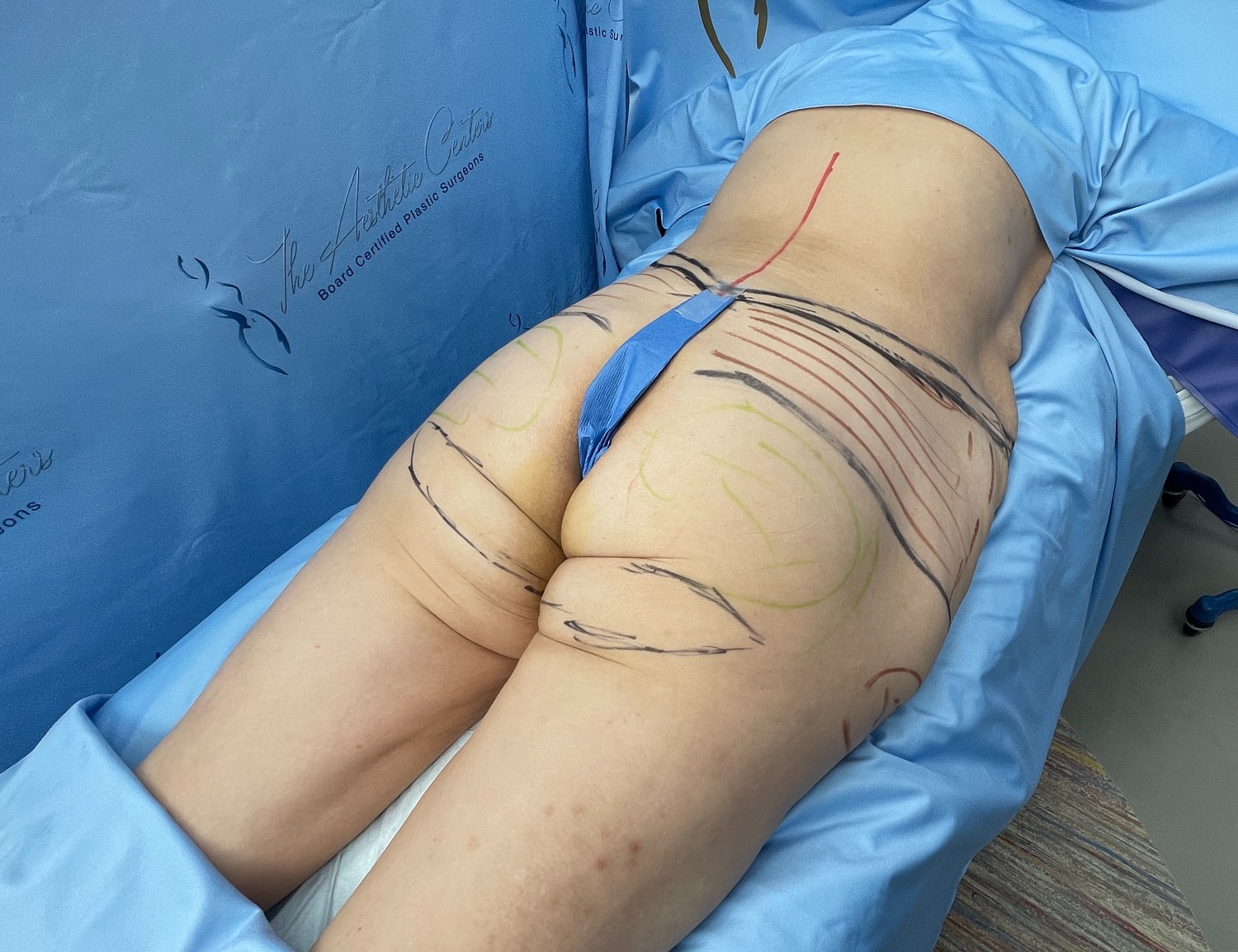
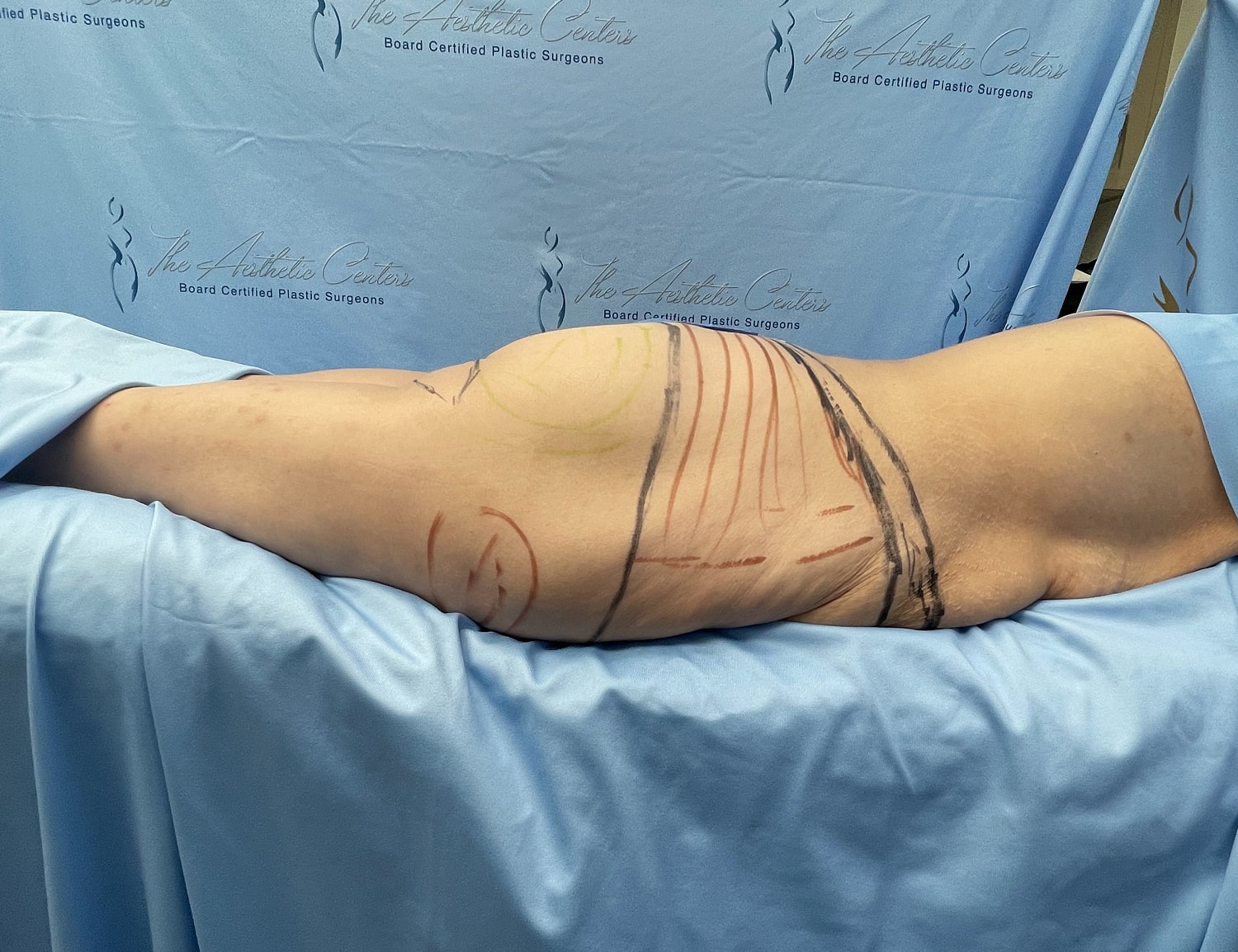
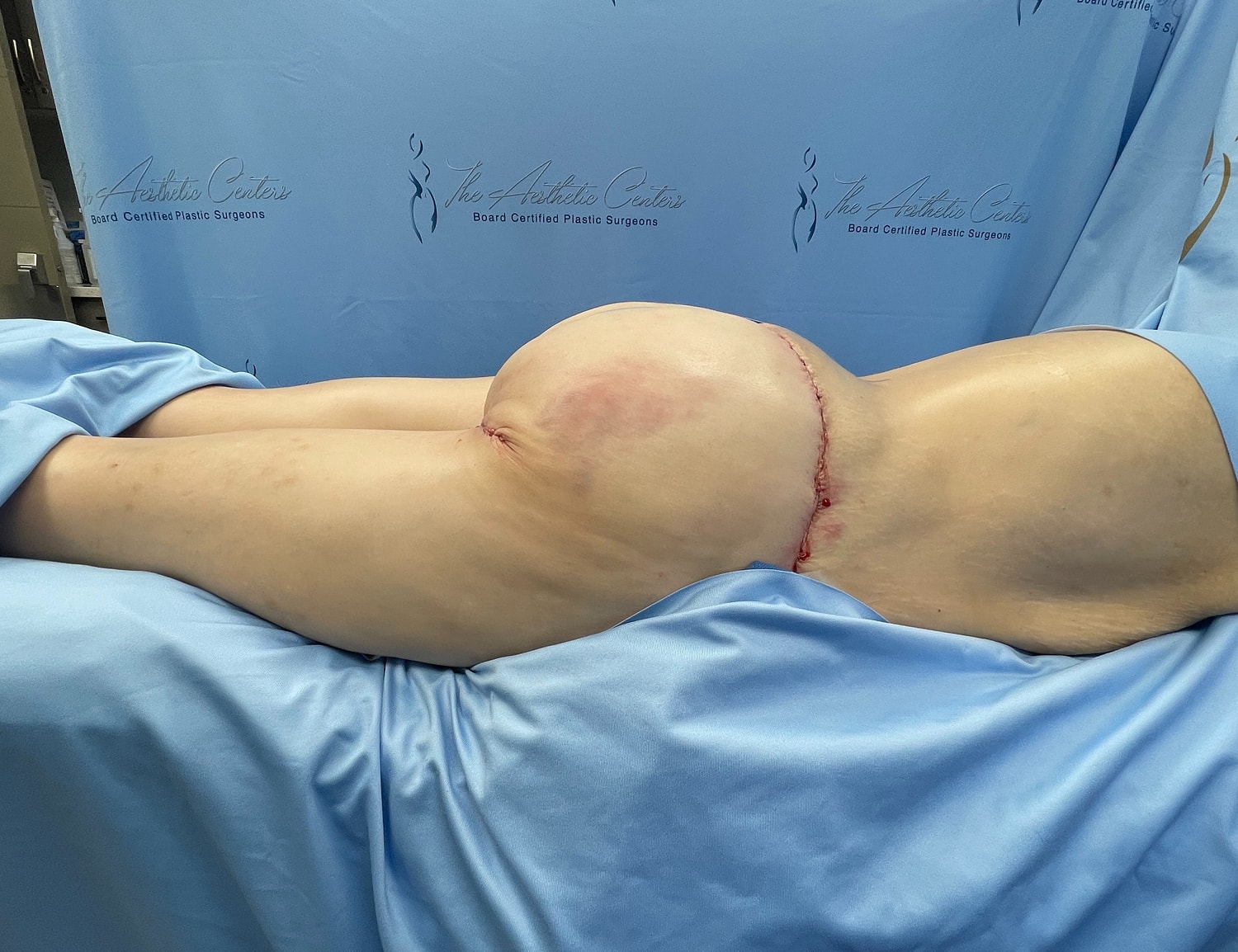
Go do the thigh lift. Cracks me up every time. So what you'll see is that we have a tremendous amount of skin laxity of the inner thighs, both vertically, so both this way and this way. And to fix it, you really need to fix both of them. So today we'll be fixing the vertical laxity, and we'll probably end up with a little bit of horizontal laxity, or laxity this way, that we'll have to fix another time. If I try to fix them both at the same time, she will end up with an opening at the junction between the T, which is very common in plastic surgery. So today we'll be removing a crescent of skin from the inner thigh and the back of the thigh, lifting that up, correcting it, and we'll probably end up with a small amount of skin this way that we can cut in the future. I don't combine these surgeries together, as I mentioned. It will increase the patient's complication rate and wound opening rate.
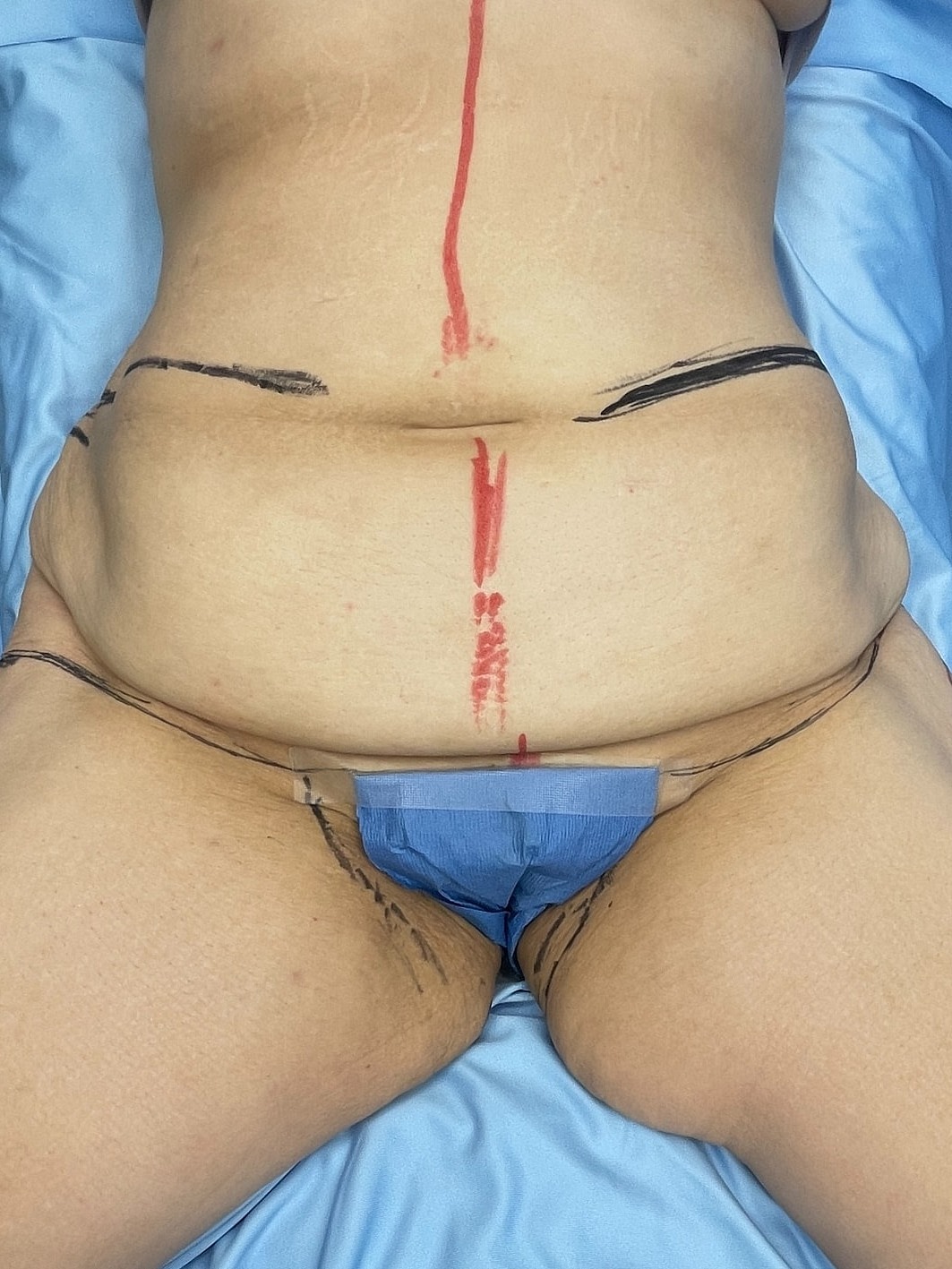
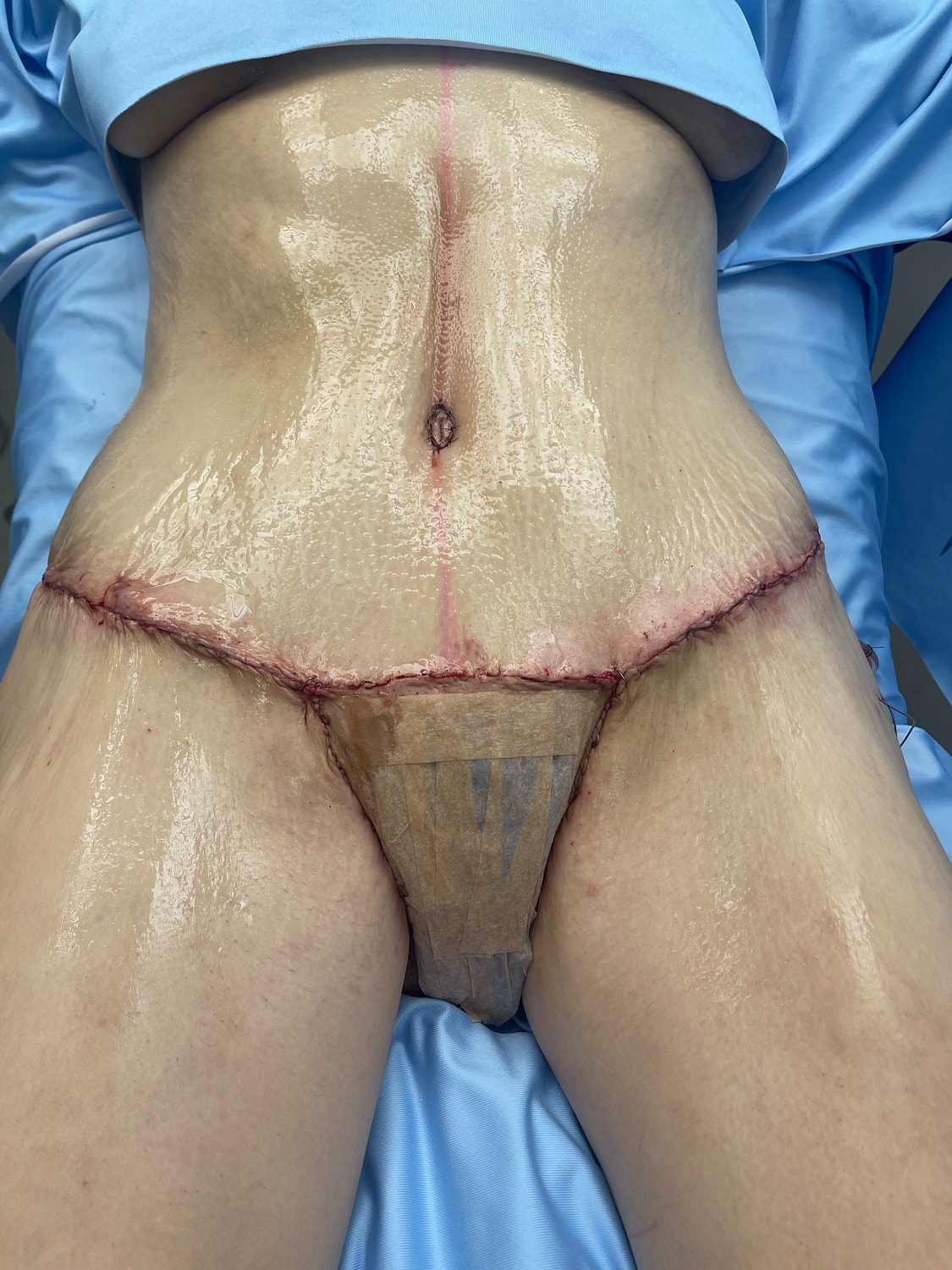
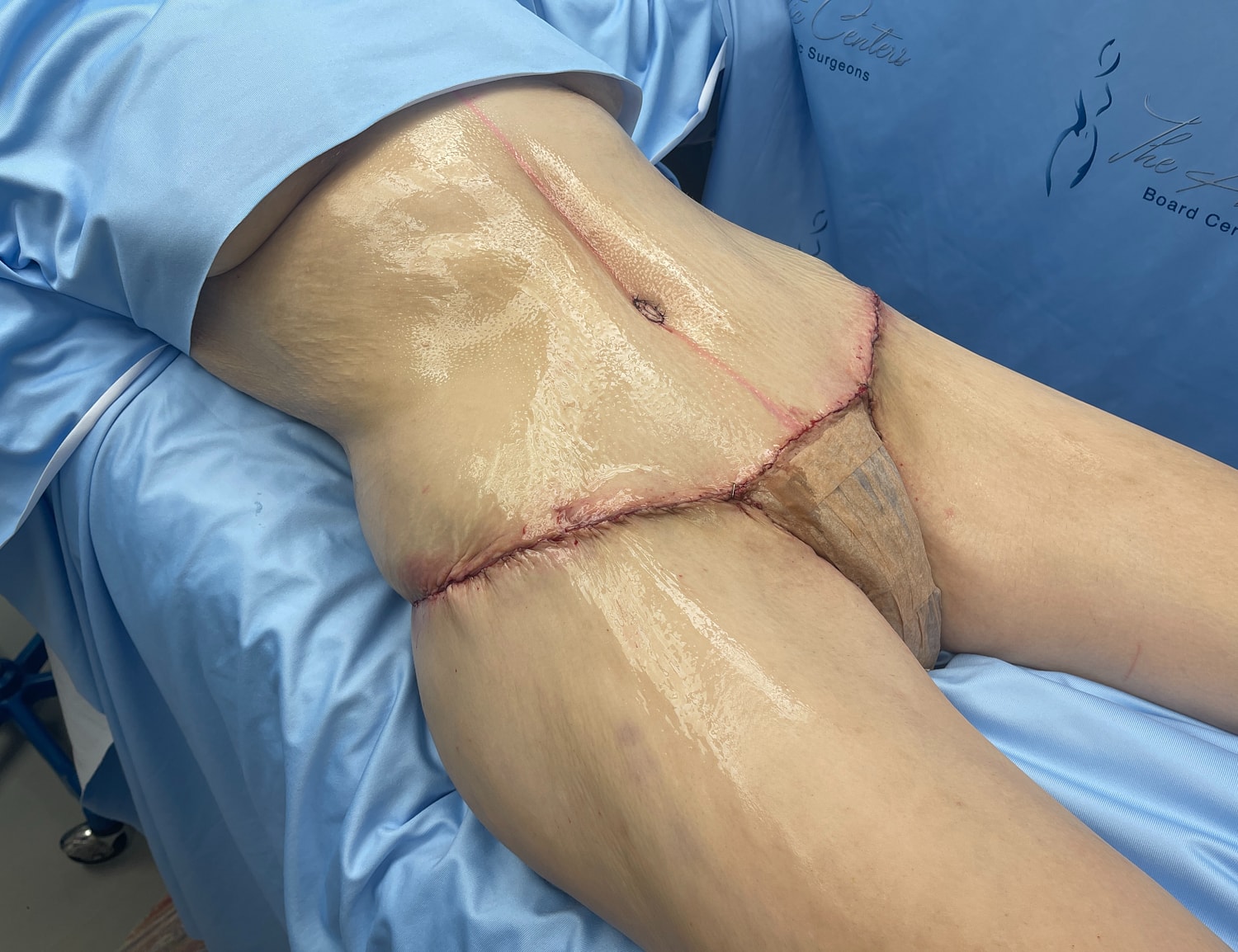
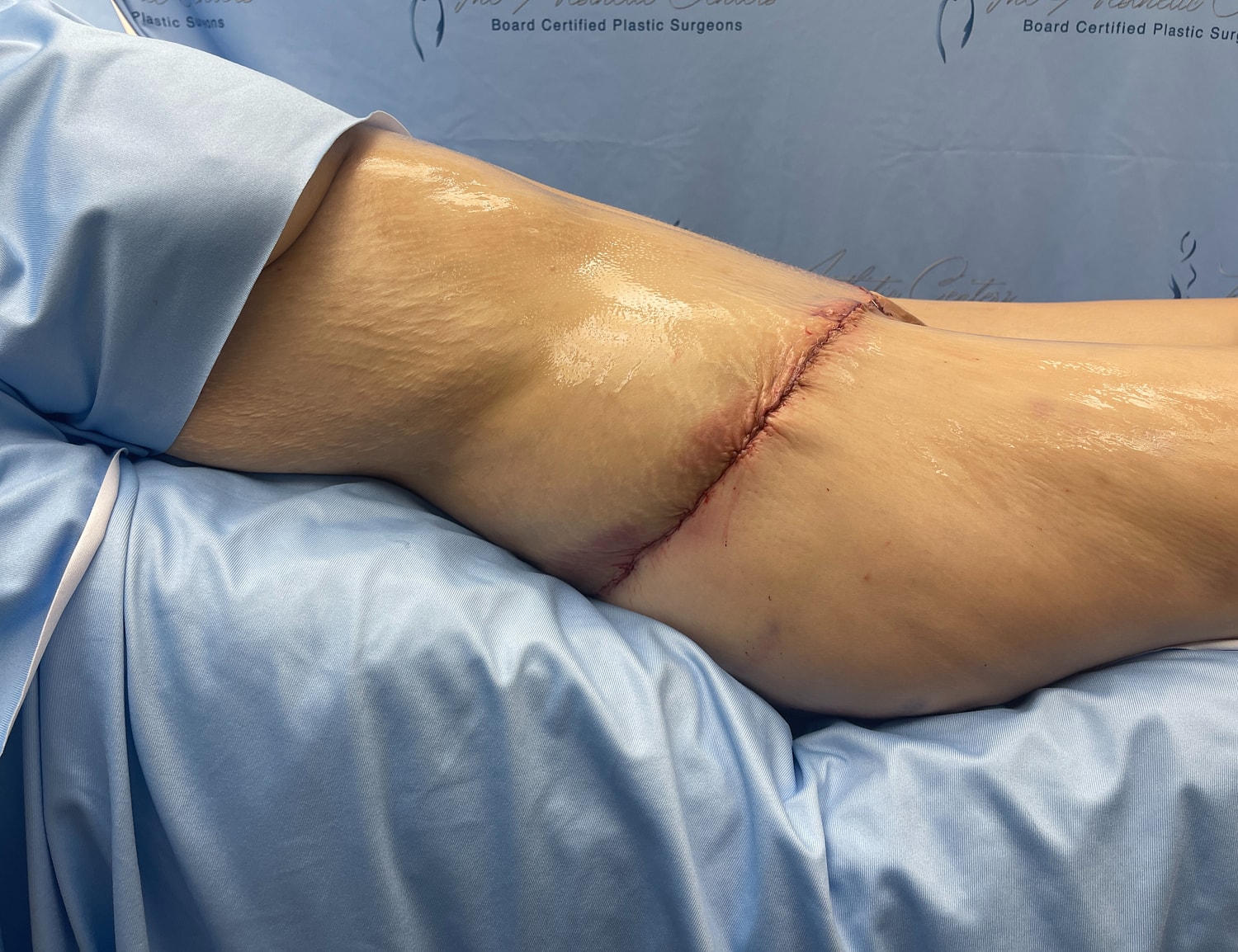
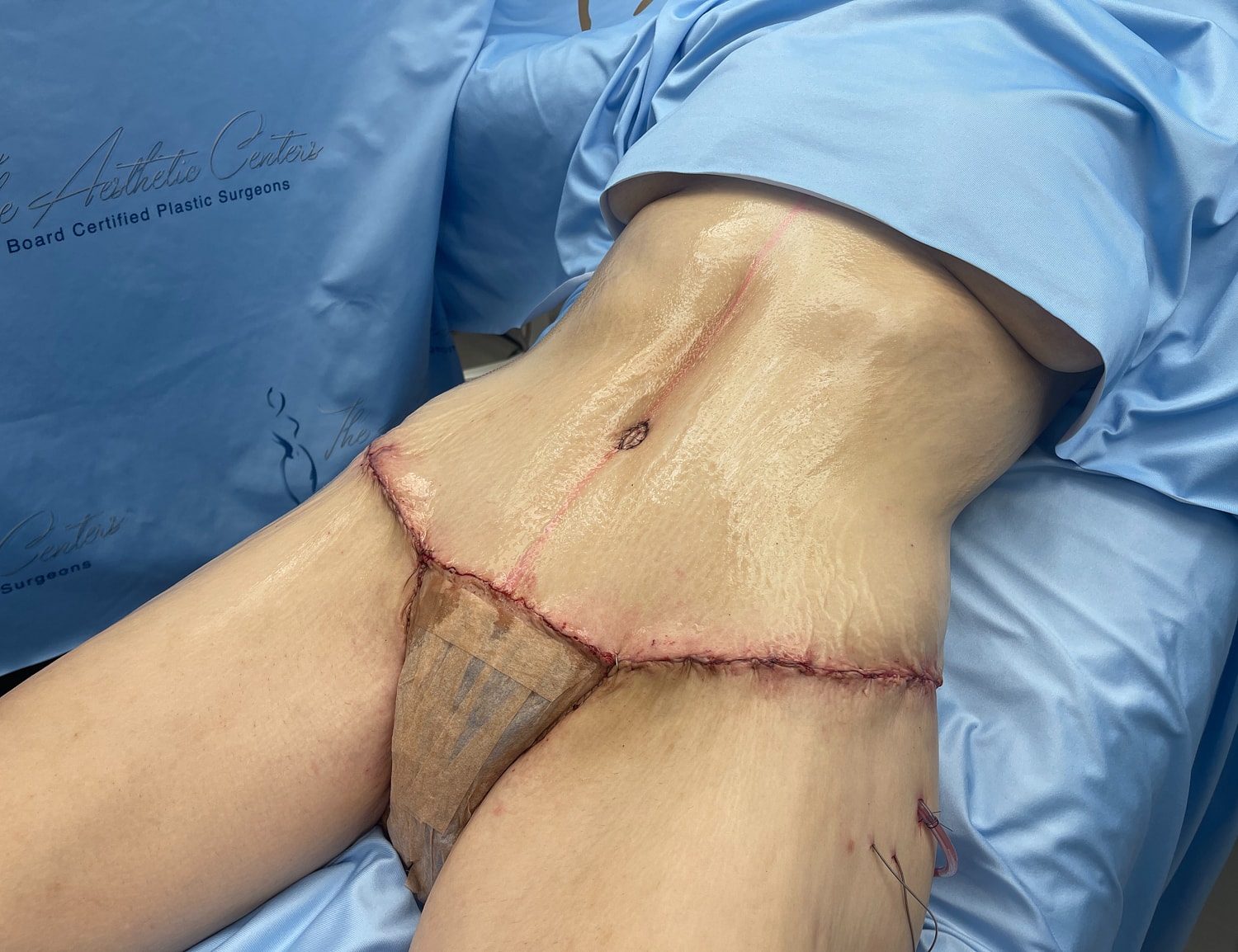
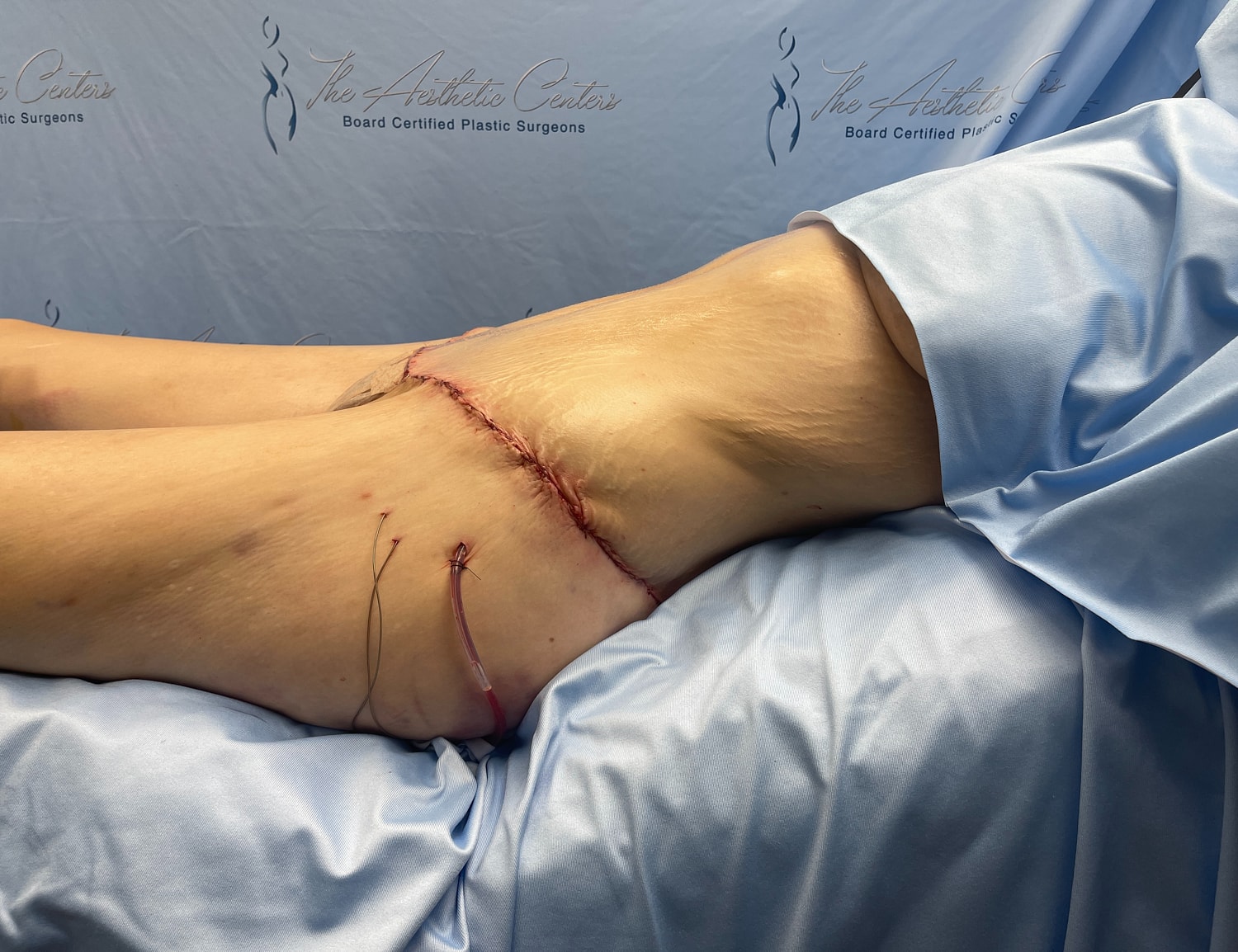
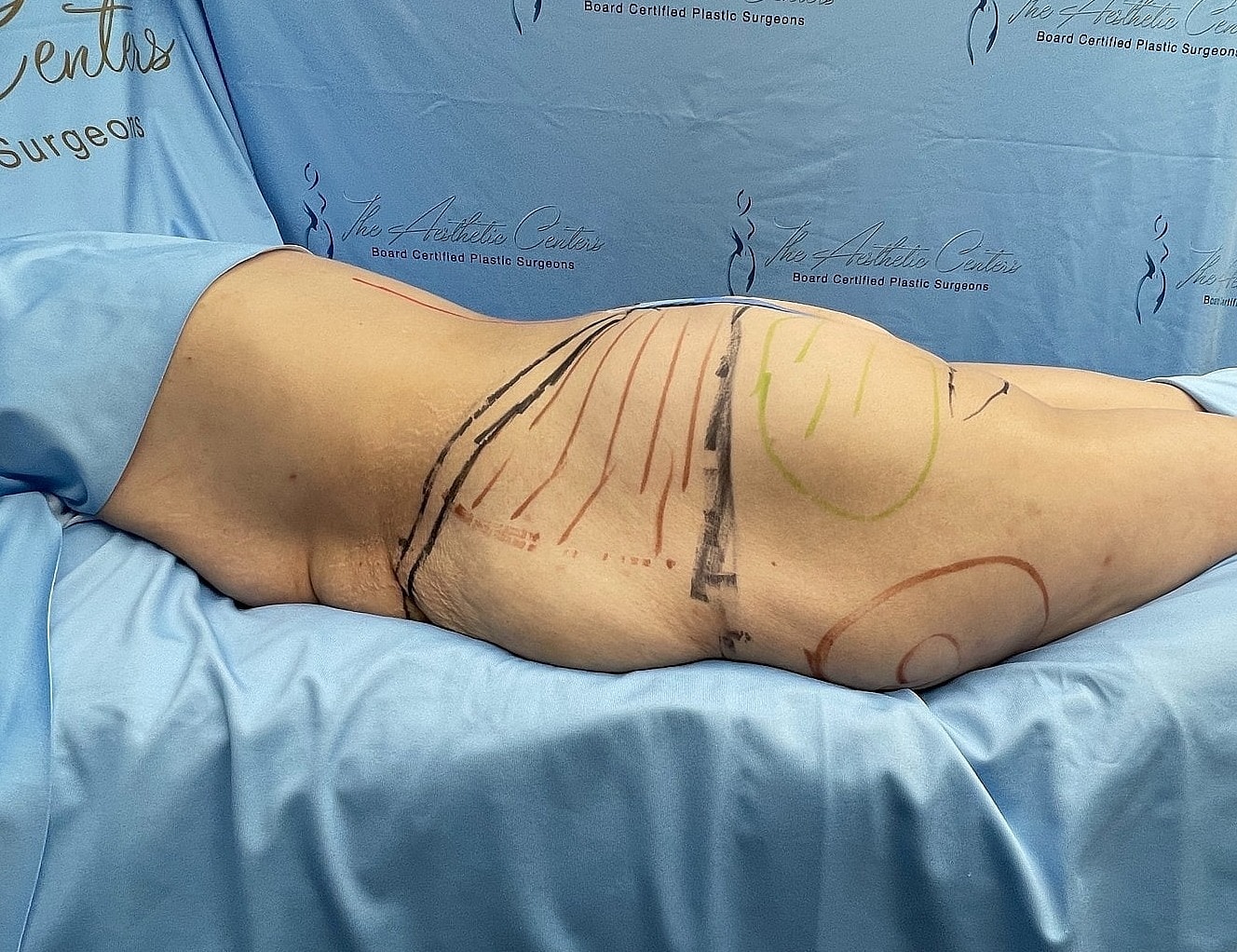
When it comes to her lower body lift, I'm going to do a High-Definition Lower Body Lift. We're going to have some skin laxity here only. Most of this will be corrected. And then when I come to reposition her breasts and do her upper body, I can correct for that. And I promised her that she will not need a fleur-de-lis tummy tuck, so I'm going to make sure that we don't need to do that. On her sides, you can appreciate how much skin we are cutting. We are probably cutting about eight or nine inches of skin and lifting this up. We're going to be liposuctioning this area a little bit.
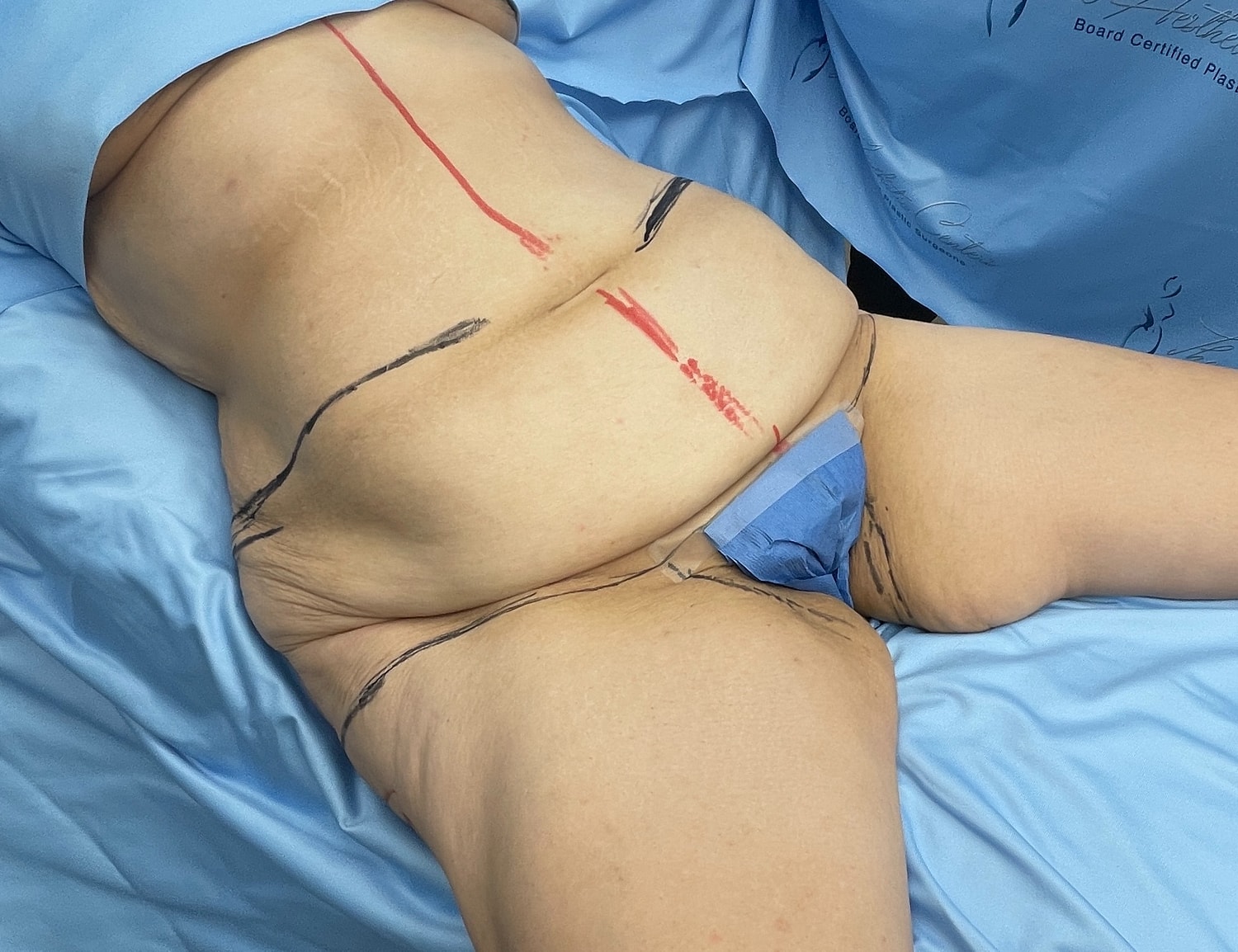
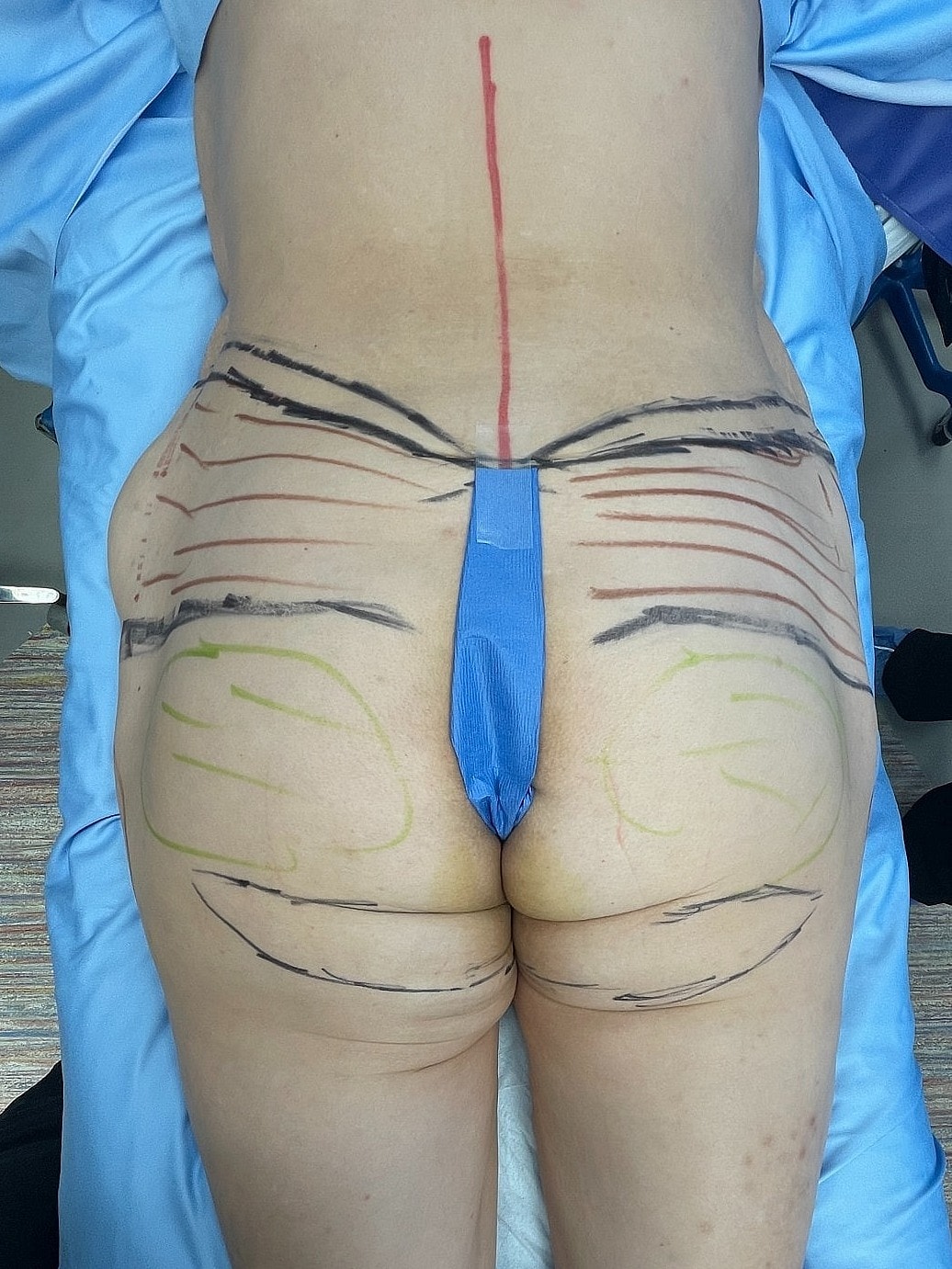
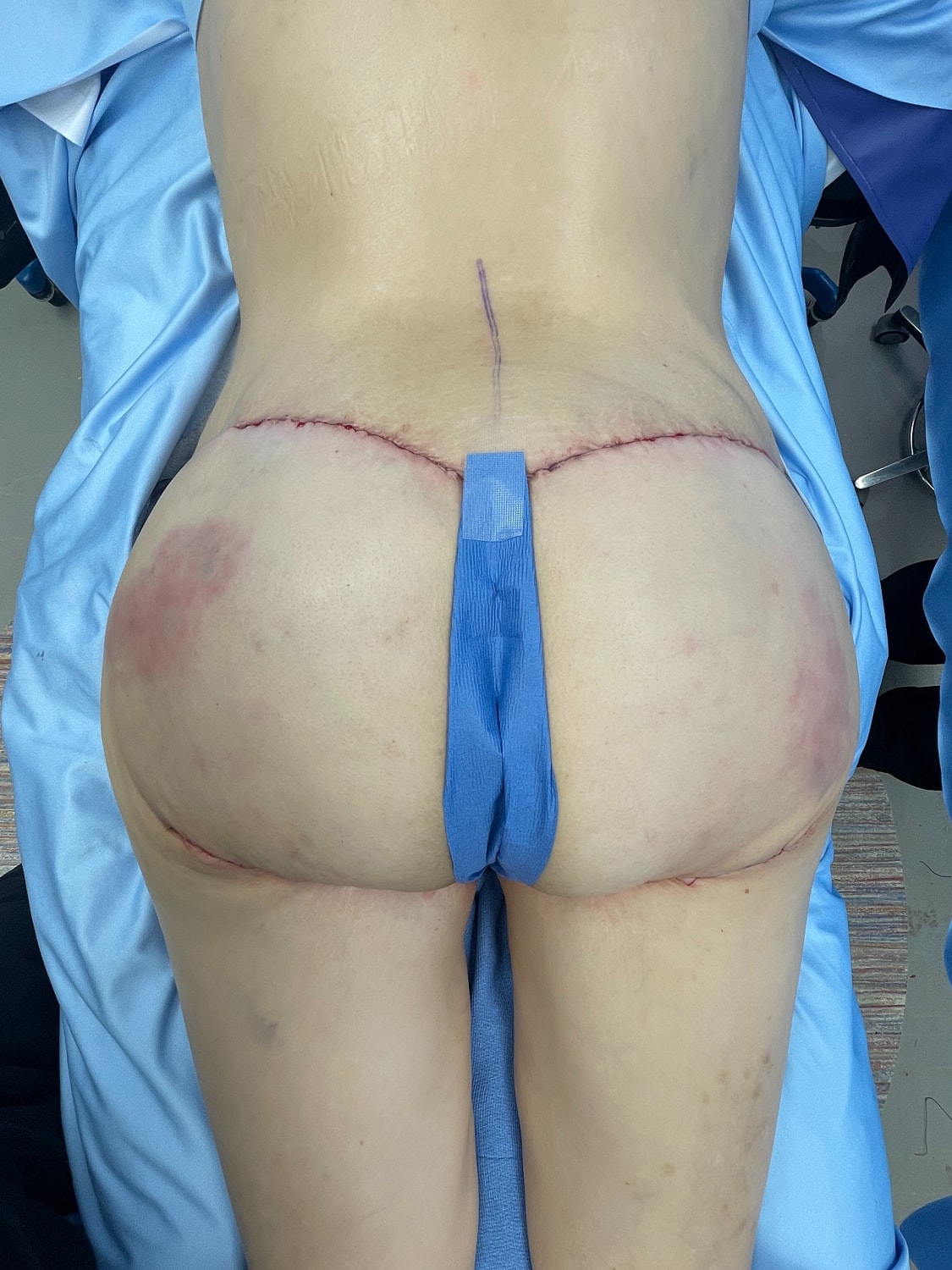
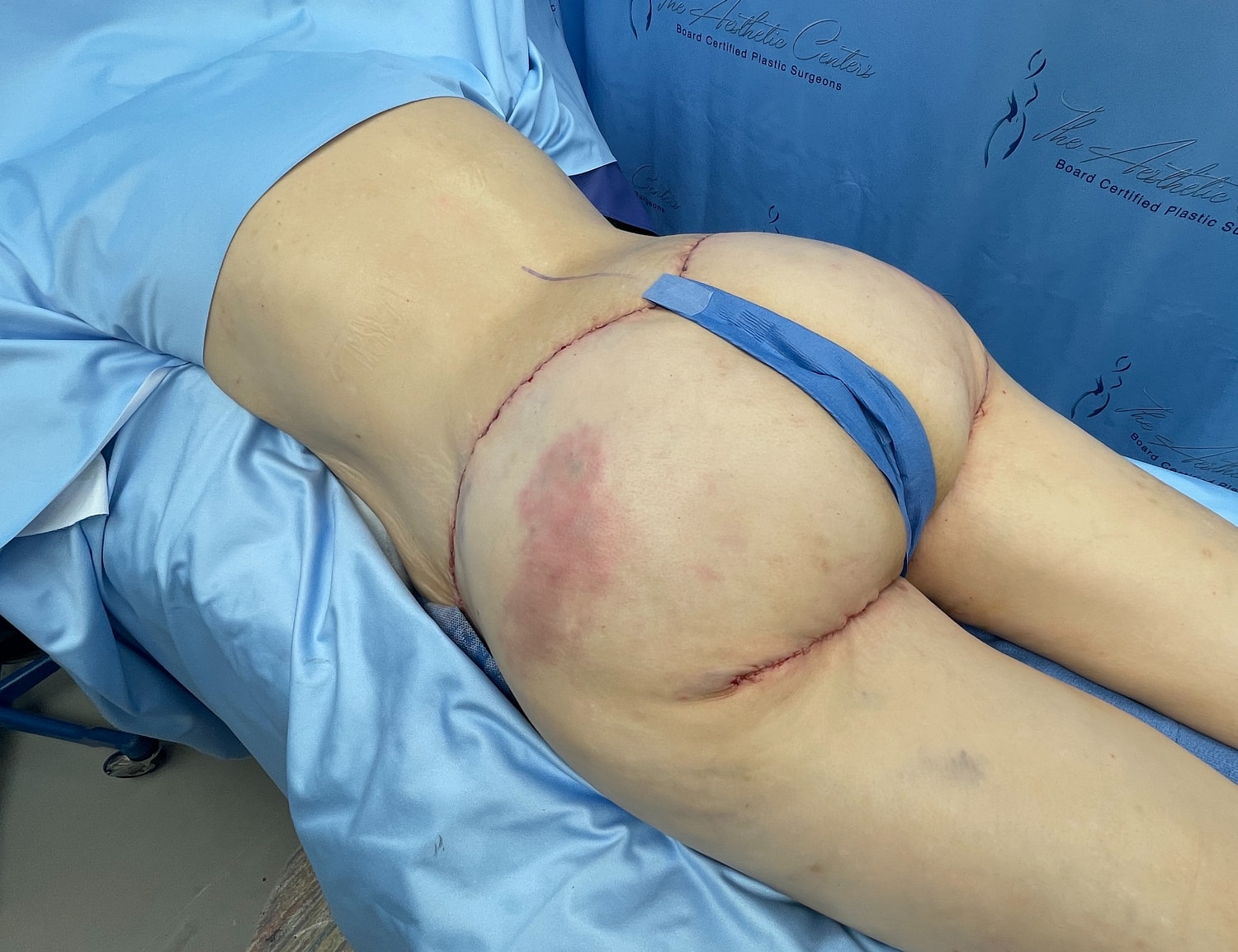
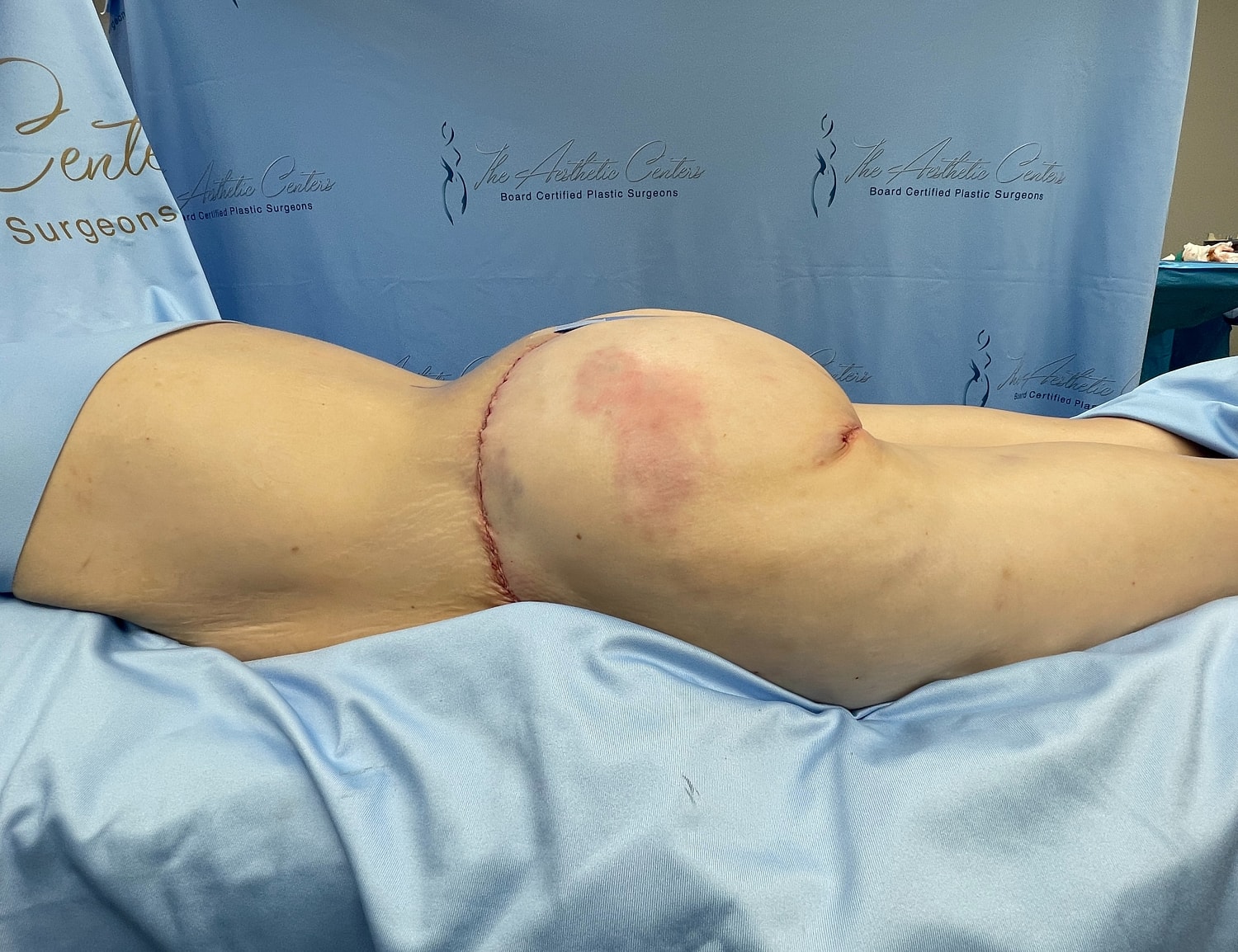
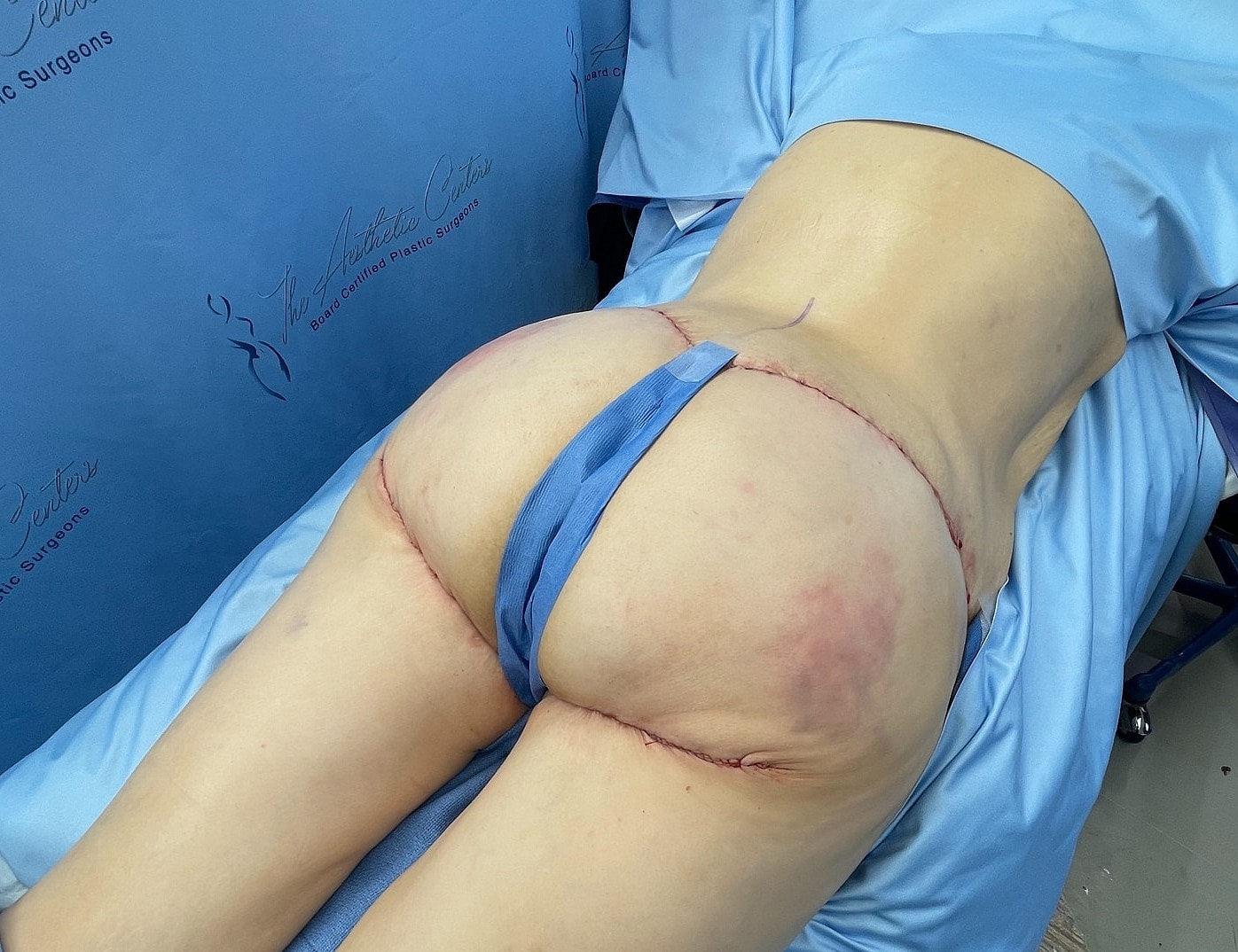
And then when it comes to her back, you'll see that this is where the surgery is the most complex. We have buttocks that are wide and long and have lost their demarcation. Here, at the junction between the buttocks and the thighs, the buttocks kind of merge into the thighs. The infragluteal crease has been lost. And what we'll be doing today is a buttock lift, buttock reshaping, buttock augmentation, creating a three-dimensional body that has been flattened as a result of the weight loss, and creating those creases so that you can appreciate her new three-dimensional physique.
As a result of the weight loss, she's kind of lost her projections and has become more two-dimensional. So removing skin, what I call cut-and-paste surgery, is easy, but that's not what we're going to do. We're going to actually create shape. We're going to actually create a body that has projection and shape and curves. And that has to do with not only removing skin, but using the remaining tissue to augment, create projection, create indentation, create creases, and so forth.
So on the back of the thighs, you see we have a lot of skin that we have to cut. We're going to do a spiral thigh lift, the procedure that we described in 2008. I'm going to recreate the infragluteal crease like this and then do a buttock augmentation and reshaping above that. We will have a little bit of skin laxity, as I mentioned, this way, and that's something that I have to come and chase in the future as I'm doing her upper body contouring.
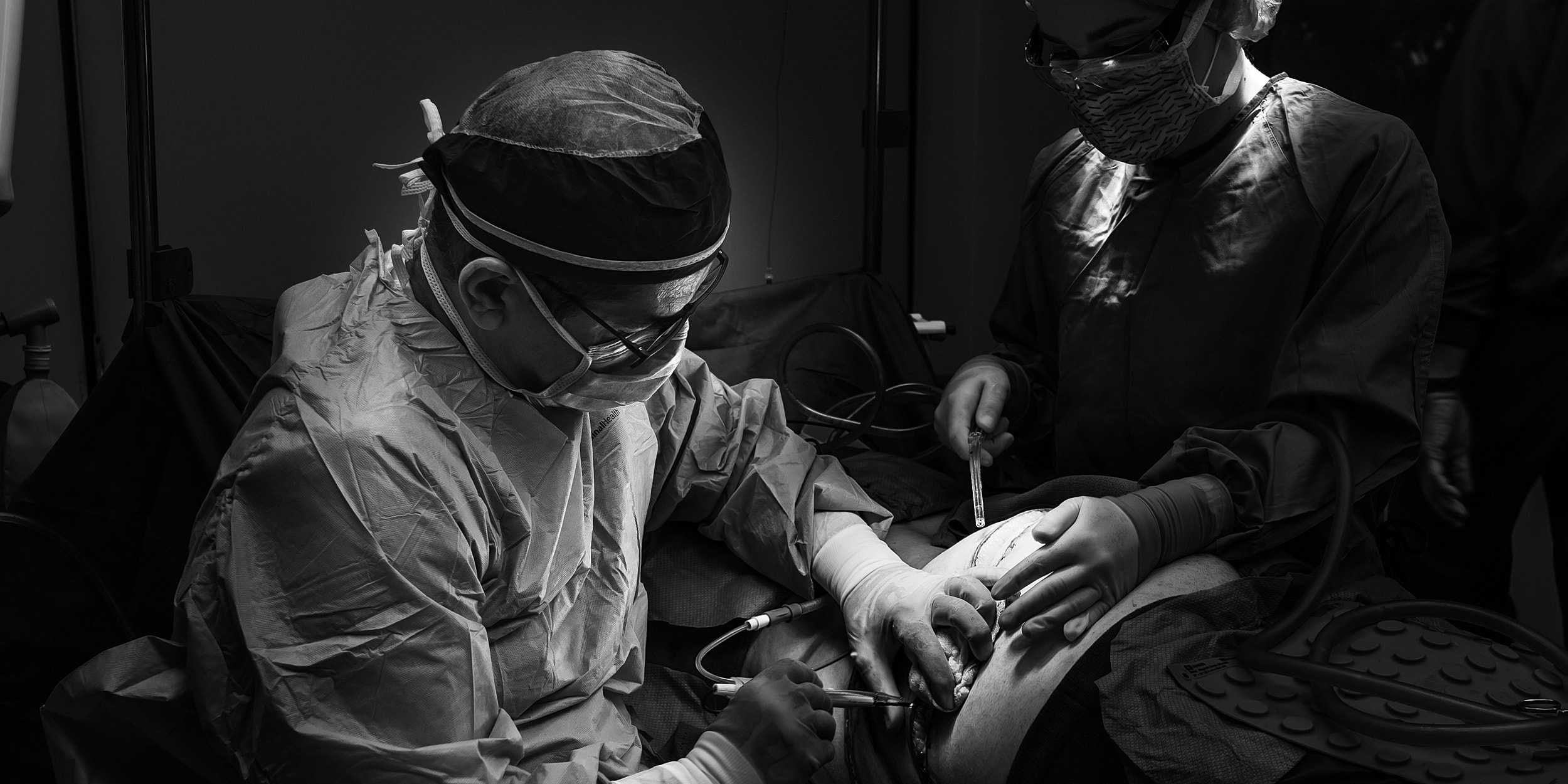
These are very, very hard and complex surgeries. I've done hundreds of them, literally, and I still think that they're hard surgeries. There's no way to sugarcoat these surgeries. And I tell patients, "You're going to be in pain." But no pain, no gain, unfortunately. We have a lot of skin. We have a lot of corrections to do. You can break up these surgeries into smaller surgeries, but then the results will never be the same, unfortunately. I wish they would because it would have made it easier for patients and me, but a lot of these surgeries go together. Even the incisions go together.
So if I want to break this into five surgeries and make it easier for her, she'll never complete all five surgeries because it's just so demanding in terms of recovery, time, and so forth. And the results will never be as good as this. Okay, ready? I'm ready. Let's do this. Very good.