

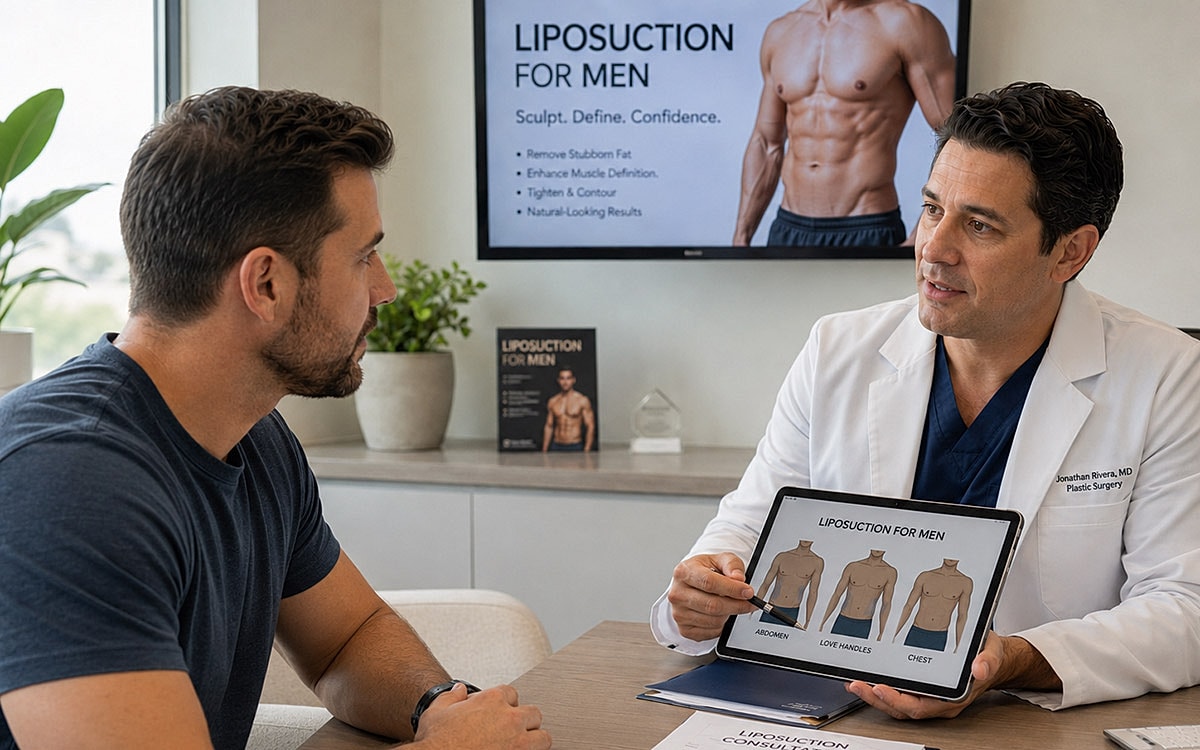
Liposuction for men most commonly targets the abdomen, flanks, chest, back, chin, and thighs, the areas where diet and exercise-resistant fat tends to settle in the male body. Results depend heavily on treatment area, skin quality, and surgeon technique, which is why a personal consultation matters more than any generic before-and-after photo. This guide breaks down what each area involves, who tends to be a suitable candidate, and what recovery looks like so you can walk into a consultation with the right questions.
You've put in the work. The gym routine is consistent, the diet is dialed in, and yet that stubborn pad of fat along your flanks or under your chin just will not budge. For many men, that's the exact moment when liposuction for men starts to feel less like a cosmetic indulgence and more like a logical next step. It's a common concern, and it's one worth understanding fully before you book anything.
Male fat distribution behaves differently than female fat distribution, which means the areas that respond best to liposuction and the techniques used to treat them aren't identical to what you'd read in a general liposuction article aimed at women. Board-certified plastic surgeon Dr. Siamak Agha at The One Plastic Surgery Center in Newport Beach evaluates each of these areas individually because a technique that flatters the abdomen isn't automatically right for the chin or the back. Below is a practical, area-by-area breakdown.
The Abdomen: The Most Requested Area for a Reason
Quick take: The abdomen is the single most common treatment area for male liposuction because visceral and subcutaneous fat tends to concentrate there first, even in otherwise fit men.
Male abdominal fat often sits in a firmer, more fibrous layer than in female patients, which is part of why an experienced surgeon's technique matters so much here. The goal isn't a six-pack carved out of nothing; it's removing the excess layer of fat that's obscuring the muscle definition you've already built. Men with good skin elasticity and a stable weight tend to see the most natural-looking contour from abdominal liposuction. For men with more excess skin than fat, a male tummy tuck may be discussed as an alternative or complement.
- Best suited for men within a healthy weight range who have a persistent fat layer, not significant excess skin
- Often combined with flank (love handle) liposuction for a continuous, natural-looking result
- Not a substitute for weight loss in men who are significantly overweight
Abdominal liposuction refines an existing shape; it doesn't build one from scratch.
Flanks and Love Handles: Where Clothes Stop Fitting Right
Quick take: The flanks, commonly called love handles, are frequently treated alongside the abdomen because fat here creates a visible break in the waistline that's particularly difficult to camouflage in fitted clothing.
This area responds well to liposuction because the fat tends to be more superficial and less fibrous than in the central abdomen. Many men notice this area first because it's what changes the fit of a dress shirt or the waistband of pants. Treating the flanks in the same session as the abdomen typically produces a smoother, more proportional waistline than treating either area alone.
- Frequently paired with abdominal liposuction in a single surgical session
- Can meaningfully change how off-the-rack clothing fits through the torso
- Skin quality in this area generally retracts well after fat removal
Male Chest: Distinct From Gynecomastia Surgery
Quick take: Chest liposuction for men addresses excess fatty tissue in the chest, which is different from surgical gynecomastia correction that removes glandular breast tissue, and the two are sometimes combined depending on what's actually causing the fullness.
A thorough consultation is essential here because chest fullness in men can come from fat, glandular tissue, or both, and each requires a different surgical approach. Liposuction alone works well when the excess is primarily fatty. When glandular tissue is present, excision may be needed in addition to liposuction for a flatter, more masculine chest contour.
- Requires a physical exam to distinguish fatty tissue from glandular tissue
- May be combined with tissue excision for a complete correction
- Compression garments are especially important in this area during recovery
Back: The Area Men Often Forget to Ask About
Quick take: Upper and lower back fat, sometimes called bra-line or flank-back fullness, is treated less often than the abdomen but can make a significant difference in how clothing drapes across the shoulders and waist.
Men rarely bring up their back unprompted, yet it's often visible in a way they don't notice themselves, especially in fitted shirts or from behind in swimwear. Because the skin on the back is thicker, this area typically requires a slightly different cannula technique than the abdomen to achieve a smooth result.
- Commonly treated in the same session as the flanks for a continuous waistline
- Requires surgeon experience with thicker back skin and tissue
- Often noticed by patients only after someone else points it out
Chin and Neck: A Small Area With an Outsized Effect on Appearance
Quick take: Submental (under-chin) fat is one of the most stubborn areas to change through diet and exercise alone, and even a modest amount of fat removal here can significantly sharpen the jawline.
This area is popular precisely because the results are so visible in everyday photos and video calls. Because the skin under the chin is thin, technique and precision matter more here than in almost any other treatment area. Men with good neck skin elasticity tend to get the cleanest results, while men with looser skin may need a complementary procedure to fully address the area.
- Often requested by men who feel their jawline photographs poorly despite a healthy weight
- Results are frequently visible within a few weeks as swelling resolves
- Skin elasticity under the chin is the biggest factor in candidacy
A small treatment area under the chin can change how a face reads in every photo taken afterward.
Thighs and Inner Knees: Less Common, Still Effective
Quick take: Thigh and inner-knee liposuction is requested less frequently by men than abdominal or flank work, but it remains an effective option for isolated fat deposits that don't respond to targeted exercise.
Men typically seek this area out when there's a specific, localized bulge rather than overall thigh size, most often on the inner thigh or just above the knee. Because this skin is thinner and more mobile than abdominal skin, a conservative, layered approach tends to produce the smoothest outcome.
- Best for isolated fat pockets rather than overall thigh circumference reduction
- Skin retraction in this area varies more than in the abdomen or flanks
- Often a secondary area addressed alongside a larger-area procedure
Recovery and Cost Factors Across Treatment Areas
Quick take: Recovery timelines and cost both scale with the number of areas treated and the technique used, so a single-area procedure and a multi-area combination case will look very different on paper and in your calendar.
Most men can return to a desk job within a week and to full exercise within three to six weeks, though every patient's timeline varies. Cost is driven by the number of areas treated, the anesthesia used, and whether liposuction is combined with another procedure like gynecomastia excision.
- Week 1: swelling and bruising are most noticeable; compression garment worn continuously
- Weeks 2-3: most visible swelling resolves; light activity typically resumes
- Weeks 4-6: strenuous exercise generally cleared; early contour becomes apparent
- Cost factors: number of areas, anesthesia type, combination with other procedures, and surgeon experience
Every patient heals differently, and these timelines are general guidance rather than a promise of your individual experience. Results and candidacy vary from patient to patient, and a personal consultation is the only way to get an accurate assessment for your body and goals.
Choosing the Right Surgeon for Male Liposuction
Quick take: Because male fat distribution and skin behavior differ from female patterns, choosing a surgeon with specific experience treating men matters as much as choosing the right treatment area.
A surgeon who primarily treats female body contouring patients may not default to the more conservative, muscle-defining approach that tends to look natural on a male frame. Ask direct questions about a surgeon's experience with male patients specifically, not just their general liposuction volume.
- Ask to see male-specific before-and-after results, not just general liposuction cases
- Confirm the surgeon is board-certified in plastic surgery
- Discuss whether a combination procedure (like gynecomastia excision) might serve your goals better than liposuction alone
If you're in Orange County, scheduling an in-person consultation in Newport Beach gives a surgeon the chance to assess your skin quality, fat distribution, and goals directly, which matters more for male liposuction planning than any photo review ever could.
Is Liposuction for Men Actually a Good Fit for You?
Quick take: Liposuction works best for men who are close to their goal weight, have reasonably good skin elasticity, and are dealing with fat that hasn't responded to diet and exercise, not for men seeking an alternative to weight loss.
It's a body contouring procedure, not a weight-loss procedure, and that distinction matters for setting realistic expectations. Men in excellent general health, with stable weight and no unmanaged medical conditions, tend to be the strongest candidates.
- Good candidates are near their target weight with isolated, stubborn fat deposits
- Skin elasticity affects how smoothly the treated area contours afterward
- Not a treatment for obesity or a substitute for sustained weight management
Ready to Talk Through Your Options?
Liposuction for men is not a standard procedure. The abdomen, flanks, chest, back, chin, and thighs each behave differently, and the right combination of treatment areas depends on your specific fat distribution, skin quality, and goals. The most reliable next step isn't more research; it's a conversation with a surgeon who can actually assess your body.
Ready to find out if liposuction is right for you? Schedule a consultation with board-certified plastic surgeon Dr. Siamak Agha at The One Plastic Surgery Center in Newport Beach to discuss your goals and options.
Frequently Asked Questions
What is the most popular liposuction area for men?
The abdomen and flanks are the most commonly requested areas for male liposuction, often treated together in a single session to create a smoother, more continuous waistline.
How is male liposuction different from female liposuction?
Male fat tends to sit in a firmer, more fibrous layer, and the aesthetic goal is usually to reveal existing muscle definition rather than reshape overall body contours, which calls for a more conservative, targeted surgical technique.
Is liposuction a weight-loss solution for men?
No. Liposuction is a body contouring procedure designed to remove stubborn, diet- and exercise-resistant fat from specific areas. It is not a substitute for sustained weight management and works best on men who are already near their goal weight.
How long is recovery after male liposuction?
Most men return to desk work within about a week and resume full exercise within three to six weeks, though recovery time varies by patient, treatment area, and how many areas were treated.
Can chest liposuction address gynecomastia in men?
Liposuction alone can address chest fullness caused primarily by fat, but true gynecomastia, which involves glandular tissue, often requires surgical excision in addition to or instead of liposuction. A consultation is needed to determine which applies to you.
Recent Post
-

Mini Tummy Tuck vs. Full Tummy Tuck: Understanding the Difference
-

The Ultimate Mommy Makeover Guide: Restoring Confidence After Motherhood
-

Tummy Tuck 2026: What’s New in Abdominal Contouring
-
Mini Tummy Tuck vs. Full Tummy Tuck: Understanding the Difference
-
The Ultimate Mommy Makeover Guide: Restoring Confidence After Motherhood