

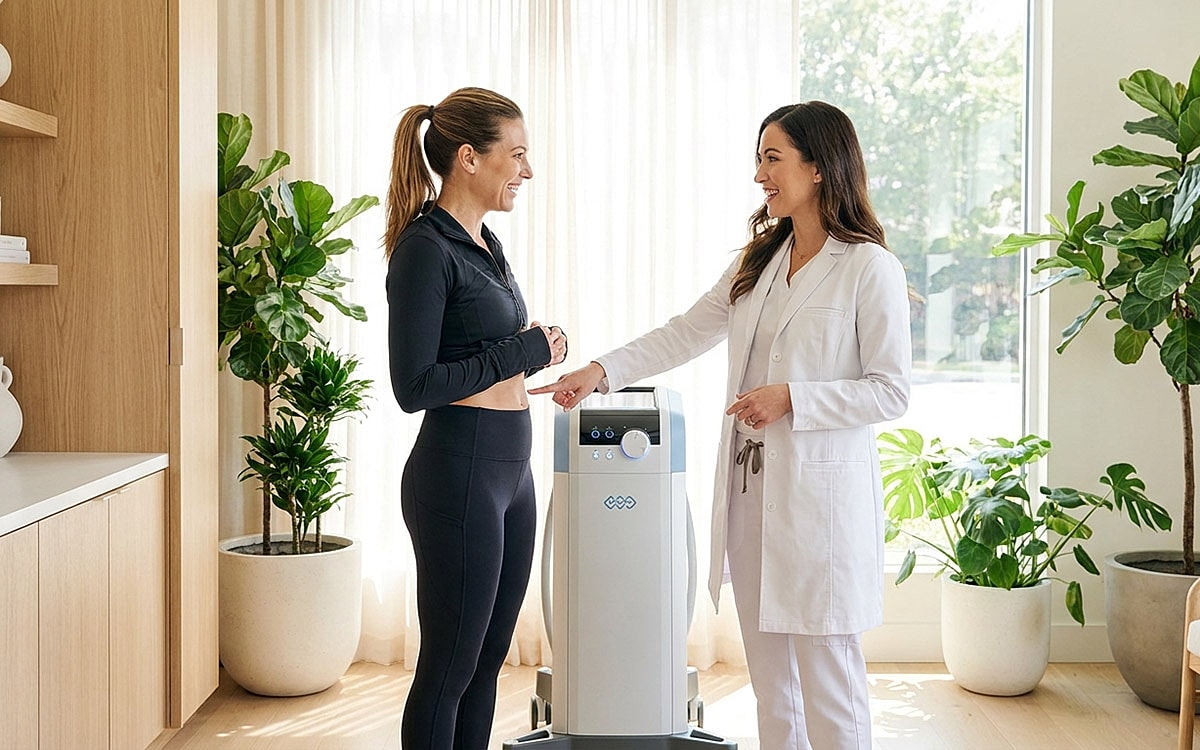
Emsculpt uses HIFEM (high-intensity focused electromagnetic) energy to trigger involuntary muscle contractions, building strength and tone in areas like the abdomen and buttocks. It is not a weight-loss treatment, and it works best on patients who are already close to their goal weight and want more definition. This guide covers how Emsculpt actually works, who qualifies, how it compares to CoolSculpting and surgical body contouring, and what patients can realistically expect from treatment in Newport Beach.
Emsculpt is not a weight-loss treatment, and it was never designed to replace a workout routine. That is the first thing to understand about Emsculpt, especially for Newport Beach patients, because marketing language around body-sculpting technology tends to blur what a device is actually built to do with what patients hope it will do. Emsculpt uses high-intensity focused electromagnetic energy, known as HIFEM, to force deep, involuntary muscle contractions that willpower alone cannot replicate at the gym. It has a specific, more limited purpose than many patients assume: toning and strengthening a handful of muscle groups, not shedding pounds or reshaping a body that carries significant excess weight. As board-certified plastic surgeon Dr. Siamak Agha explains to patients considering med spa options at his Newport Beach practice, Emsculpt earns its popularity by doing one job well rather than promising to do everything. Understanding that distinction is what separates a patient who is thrilled with the results from one who walks away disappointed.
What Emsculpt Is Built to Do, and What It Isn't
The confusion around Emsculpt usually starts with the phrase "burn fat," which sounds like a weight-loss claim even though that is not how the technology is classified or how it performs.
According to The Aesthetic Society, nonsurgical body contouring treatments, including HIFEM devices, are not weight-loss tools, and patients who are generally overweight are not good candidates for them. The treatment is meant for people who are already near a stable, healthy weight and want to address stubborn areas that resist diet and exercise.
That distinction matters because federal guidance on powered muscle stimulators is notably narrow. The FDA's own compliance policy on electrical muscle stimulators makes clear that no muscle stimulation device is cleared for girth reduction, weight loss, or general body shaping claims on its own. Devices like Emsculpt instead carry specific clearances tied to muscle toning, firming, and strengthening, a narrower and more defensible claim than the "burn fat while you lie there" pitch patients sometimes encounter in marketing materials.
Why Muscle Contraction, Not Fat Melting, Is the Real Story
Once the weight-loss misconception is cleared up, the actual mechanism is easier to understand. Emsculpt's HIFEM applicator delivers electromagnetic pulses that force targeted muscles, most often in the abdomen or buttocks, into supramaximal contractions far beyond what a voluntary crunch or squat can achieve. A single 30-minute session can generate roughly 20,000 of these contractions, which is why patients often describe the sensation as an unusually intense workout rather than a passive spa treatment.
Muscle tissue that contracts repeatedly and forcefully adapts the way it would after a demanding strength-training block: fibers thicken, tone improves, and the treated area often looks firmer and more defined. A retrospective study published and indexed on PubMed found consistently high satisfaction rates among patients using electromagnetic muscle stimulation, linking these rates to improvements in muscle tone rather than dramatic changes on the scale. That is the honest version of the "burn fat" claim: some localized fat reduction can occur alongside the muscle-building effect, but the headline result is tone and definition, not weight loss.
How HIFEM Technology Works Beneath the Skin
A typical Emsculpt protocol involves four sessions spaced roughly a week apart, with each session targeting one or two specific muscle groups such as the abdomen, buttocks, thighs, arms, or calves. The applicator sits against the skin over the target muscle and delivers electromagnetic energy in cycles, alternating between intense contraction and brief rest, without needles, incisions, or anesthesia. Patients typically return to normal activity immediately afterward.
Research on combined radiofrequency and electrical muscle stimulation protocols, published in the peer-reviewed literature on PubMed Central, has documented measurable improvements in waist circumference and muscle tone when these energy-based approaches are applied in a structured series. The practical takeaway is that Emsculpt is a cumulative treatment. A single session produces a strong workout-like sensation, but the tone and firmness patients notice build gradually across the full series, much like the results of a consistent strength-training program.
Who Actually Qualifies for Emsculpt
Good candidacy for Emsculpt has less to do with a number on the scale and more to do with where a patient already stands. Guidance summarized by the American Society of Plastic Surgeons notes that nonsurgical body contouring works best for patients who are near their target weight but want to refine specific areas that remain resistant to diet and exercise, such as a soft midsection or a buttock that has lost some shape over time. Patients who are significantly overweight or seeking noticeable weight loss typically benefit more from discussing other options first.
There are also a handful of situations where Emsculpt is not appropriate, and because that list is genuinely a list rather than something that reads naturally as prose, it is worth stating plainly. Emsculpt is generally not recommended for pregnant patients, who have a pacemaker or other implanted electronic device, who have metal implants near the treatment area, who have an active hernia near the treatment site, or who have a bleeding disorder or recent surgical incision in the area being treated. A consultation is the appropriate place to review individual health history against this list, since candidacy always depends on the specifics of each patient's situation.
Emsculpt Newport Beach Options: Comparing HIFEM to CoolSculpting and Surgical Contouring
Patients researching med spa treatments in Orange County often ask how Emsculpt stacks up against CoolSculpting, and the honest answer is that the two technologies solve different problems. CoolSculpting relies on cryolipolysis, using controlled cooling to reduce fat cells in a treated area, while Emsculpt uses electromagnetic energy to build and tone muscle, with some secondary fat effects. Patients who want a more sculpted, defined appearance in an area that already has reasonable fat coverage tend to respond well to Emsculpt, while those whose primary concern is stubborn fat volume may see more from a fat-reduction approach or a combination of the two.
Surgical body contouring enters the conversation when nonsurgical technology reaches its limits. Liposuction and procedures like a tummy tuck can remove a meaningful volume of fat and, in the case of a tummy tuck, address loose or stretched skin and separated abdominal muscles in ways no energy-based device can. Patients exploring the full range of options at The One Plastic Surgery Center often start with a nonsurgical treatment like Emsculpt and, if their goals shift, transition into a surgical consultation once they understand where the line between the two approaches actually falls.
What Results Really Look Like, and How Long They Hold
Emsculpt tones the muscles you already have; it does not replace the volume-removing work of surgery.
Most patients begin noticing a firmer tone in the treated area a few weeks after finishing their session series, with improvement continuing to develop over one to three months as the body responds to muscle adaptation. Results are not permanent in the sense that muscle, like any tissue built through exercise, requires some level of ongoing activity to maintain. Patients who stay active tend to hold onto their results longer than those who return to a fully sedentary routine.
It is also worth being direct about variability. Individual response to HIFEM technology depends on baseline muscle mass, body composition, and how consistently a patient completes the full session series, and no reputable provider should promise a specific outcome before ever examining a patient in person. That variability is precisely why a consultation, not a marketing photo, is the right basis for expectations.
Setting Realistic Expectations for Emsculpt Newport Beach Patients
Because Emsculpt sits at the intersection of med spa convenience and genuine physiological effect, it benefits from real medical oversight rather than being treated as a purely cosmetic add-on. At The One Plastic Surgery Center in Newport Beach, Emsculpt is offered as part of a broader body-contouring conversation grounded in the training of a board-certified plastic surgeon, which means patients get an honest read on whether HIFEM technology fits their goals or whether a different treatment, surgical or nonsurgical, would serve them better.
Results and candidacy vary from patient to patient, and any decision about Emsculpt or another body-contouring option should follow a consultation where a provider can review individual health history and goals in person.
The Bottom Line on Emsculpt
Emsculpt earns its place in a med spa menu by doing something specific and genuinely useful: using HIFEM technology to build and tone muscle in a way voluntary exercise cannot fully replicate, with a modest secondary effect on localized fat. It was never built to be a weight-loss shortcut, and patients who understand that distinction going in tend to be the ones most satisfied with what they see in the mirror afterward.
Ready to find out if Emsculpt is right for you? Schedule a consultation with board-certified plastic surgeon Dr. Siamak Agha at The One Plastic Surgery Center in Newport Beach to discuss your goals and options.
Frequently Asked Questions
Is Emsculpt a weight-loss treatment?
No. Emsculpt uses HIFEM technology to build and tone muscle, with a modest secondary effect on localized fat in the treated area. It is not designed or cleared to produce significant weight loss, and patients looking primarily to lose weight are usually better served by a different conversation first.
How many Emsculpt sessions are typically needed?
Most protocols involve about four sessions spaced roughly a week apart, with each session targeting a specific muscle group such as the abdomen or buttocks. Results tend to build gradually across the full series rather than after a single visit.
Is Emsculpt painful?
Emsculpt does not require anesthesia and most patients describe the sensation as an intense muscle workout rather than pain. The applicator triggers strong, involuntary contractions in the treated muscle, which can feel unfamiliar at first but is generally well tolerated.
Who should avoid Emsculpt?
Emsculpt is generally not recommended for pregnant patients or those with a pacemaker, another implanted electronic device, metal implants near the treatment area, an active hernia, or a bleeding disorder. A consultation is the right place to review individual health history before treatment.
How is Emsculpt different from CoolSculpting or surgical body contouring?
CoolSculpting reduces fat cells through controlled cooling, while Emsculpt uses electromagnetic energy to build and tone muscle. Surgical options like liposuction or a tummy tuck can remove larger volumes of fat and address loose skin in ways no nonsurgical treatment can.
Recent Post
-

Tummy Tuck 2026: What’s New in Abdominal Contouring
-

Mini Tummy Tuck vs. Full Tummy Tuck: Understanding the Difference
-
Tummy Tuck 2026: What’s New in Abdominal Contouring
-
Mini Tummy Tuck vs. Full Tummy Tuck: Understanding the Difference
-

The Ultimate Mommy Makeover Guide: Restoring Confidence After Motherhood